The LEAD Lab currently has several active studies recruiting children between the ages of 20 months and 12 years. We are looking for children who struggle with language, reading, and/or learning as well as children with typical language development.
investigates how children with atypical language development use feedback to learn new information. A better understanding of how children learn new information will improve the way educators teach children with different language/learning profiles.

explores how children with and without language difficulties use self-talk to complete complex tasks and whether certain types of training can change how inner speech is used. Results of this study will help us create strategies to make complex tasks easier for children with language impairments.
examines how children with and without language difficulties detect patterns from streams of information. A better understanding of how children learn statistical patterns can potentially lead to early detection of developmental language disorder.

investigates how children with typical and delayed language development pick up on patterns in their linguistic environment. This information may improve our ability to predict developmental language disorder.
All of our studies take place at the MGH Institute in the Charlestown Navy Yard and involve activities to measure your child’s language, reading, thinking, and learning abilities. Your child will be asked to complete some paper/pencil tasks, provide spoken responses to questions, and play some games on the computer. You (the caregiver) will be asked to complete some questionnaires about your child’s developmental history and behavior.
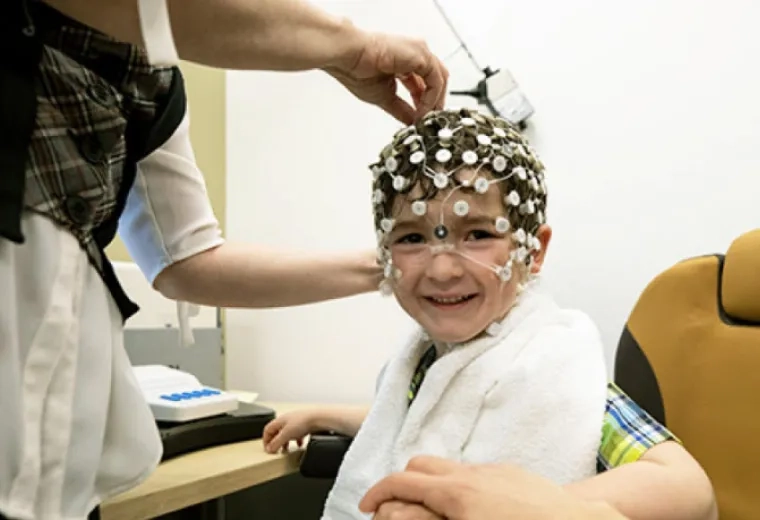
During some of the computer tasks, we will record your child's brain activity using electroencephalography or EEG. EEG is a safe, non-invasive way to measure electrical signals in the brain. It does not send any signals or radiation, and it does not record thoughts. Your child will feel like they are wearing a swimming cap.
Specific details about each study are available in the links above.
Your child will not receive any treatment or immediate benefit from participating in a research study. However, the results of our research may benefit children, families, clinicians, and teachers who care about language and learning development.
We provide free, convenient parking and compensate you for your time. Your child will also get to choose a small toy from our prize box at the end of each visit. For some studies, we provide a summary of your child’s test scores. Specific details about each study are available in the links above.
You can express interest in a specific study by clicking one of the links above. You can also simply email us at cnglead [at] mghihp.edu (cnglead[at]mghihp[dot]edu) to set up a screening call. We will ask you a few questions and tell you which study is a good fit for your child. You may also call us at (617)-724-7363.
Take the next step