

MGH Institute Faculty Presents at National Gathering for Advancing Humanism in Healthcare
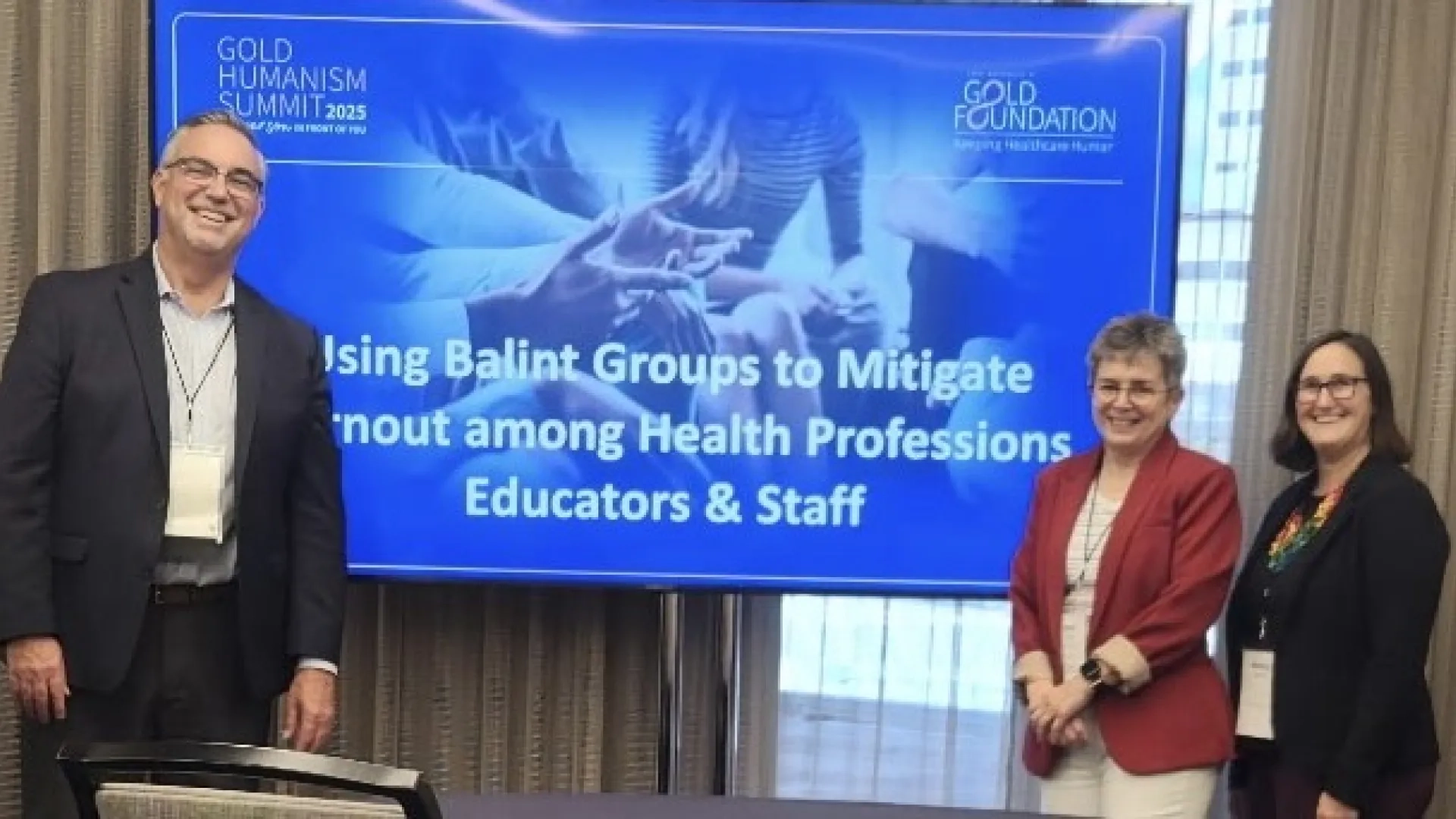


Faculty from the MGH Institute of Health Professions presented at the Arnold P. Gold Foundation Summit in Baltimore, MD — a national gathering dedicated to advancing humanism in healthcare, which includes kindness, safety, and trustworthiness.
The team of Midge Hobbs, Assistant Dean of Interprofessional Education; Mike Boutin, Assistant Dean for Faculty and Student Success in SHRS; and Monica Arrigo, Assistant Professor in the Department of Physical Therapy, led a Balint workshop based on their experience running Balint groups with students, faculty, and staff at the Institute. Attendees were introduced to this structured, psychologically safe, reflective practice for exploring the emotional aspects of relationships in healthcare and education. Using a mock Balint group with volunteers, the team demonstrated how Balint groups can encourage empathy, build connection, encourage perspective-taking, and strengthen resilience—valuable tools that support well-being, combat burnout, enhance community, and help sustain compassionate care.
“Following the workshop, many attendees shared how impactful and relevant the experience had been,” noted Hobbs. “They also discussed ways to incorporate Balint groups into their various settings and emphasized that, in these challenging times, developing connections, compassion, resilience, and community is crucial for health professions education and practice.”
In collaboration with Dr. Regina Doherty, Associate Provost for Faculty Affairs and Dean of the Center for Interprofessional Education and Practice, Hobbs presented a poster titled, "Read, Reflect, and Appreciate the Perspectives of Others: Outcomes of an Interprofessional Common Reading Program.” The poster’s focus was on the Institute’s Common Reading Program, a humanities-based initiative utilizing literature and shared discussion to help incoming students develop empathy, perspective-taking skills, and ethical awareness. They then apply these foundational skills in their interprofessional learning experiences through the IMPACT series.
“It’s such a simple idea,” shared one attendee, “but literature is such a great way to help students see the world through someone else’s lived experience.”
Both presentations embodied the Summit’s mission by demonstrating how the humanities can promote compassion, belonging, and human connection in health professions education. The Center for Interprofessional Education and Practice has used the humanities to support various learning experiences over the years. The MGH Institute now plans to expand its humanities-based programs to further enhance healthcare education and also address the well-being of faculty and staff. This includes ongoing Balint groups, a humanities-based program for students, as well as workshops and training sessions for faculty, staff, and alumni.