

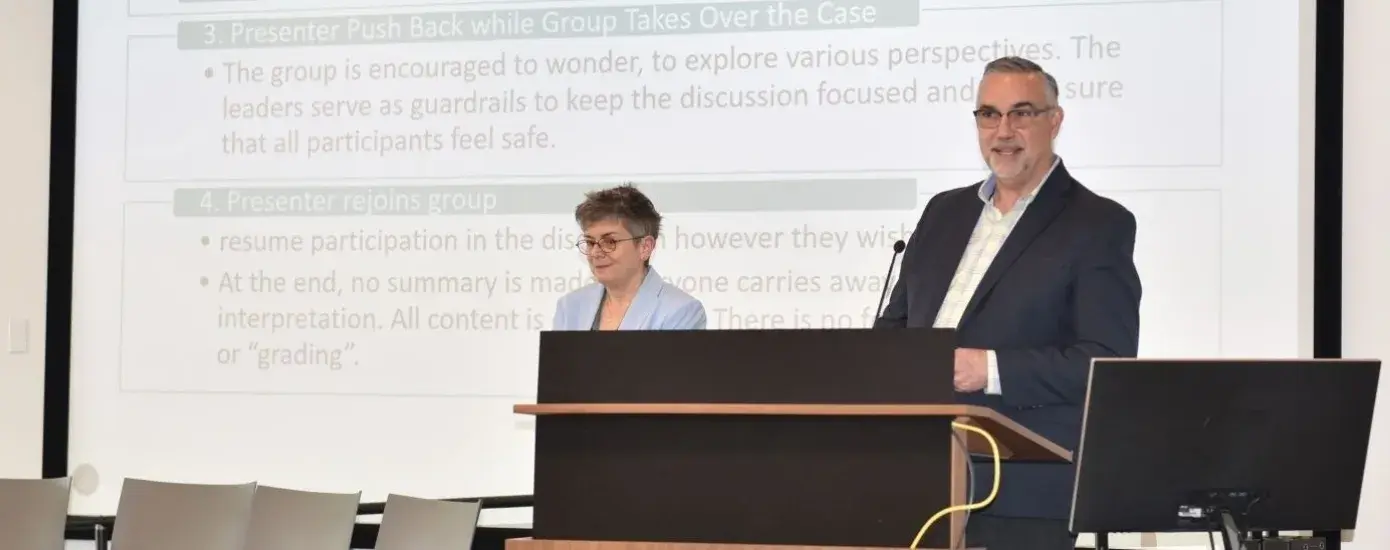
SHRS Assistant Dean for Faculty and Student Success Mike Boutin facilitated a mock Balint group during a genetic counseling conference held at the MGH Institute in May.


Several programs from the MGH Institute’s School of Health and Rehabilitation Sciences support students who are experiencing new and challenging interactions during their clinical rotations by helping them understand their emotions and relationships that are vital to their work through Balint groups. SHRS Assistant Dean for Faculty and Student Success Mike Boutin, EdD, spoke to OSC’s Lisa McEvoy about why Balint groups are important and why he has led efforts to integrate Balint groups at the MGH Institute.
What is Balint?
Balint groups were established in the 1950s by Michael and Enid Balint. They were a husband-and-wife team of psychoanalysts who cared for traumatized clinicians in the UK after WWII. Balint groups focused on the relationships that exist between the patient and the clinician, and in the clinical encounter. Rather than focus on patient outcomes, they looked at the emotional and relational components. That is the part that tends to stick with clinicians, and we know if those emotions don’t get resolved, it can result in burnout.
Balint groups is a facilitated group process. It is a four-part process with a fixed and confidential group to promote psychological safety. What happens in Balint, stays in Balint. The group sits in a circle. There are two facilitators trained in the Balint model, one of whom takes the group through the process and the other of whom is more the timekeeper and provides a second set of eyes. The facilitator starts by calling for a case and waiting until someone brings a case forward. Usually, the group waits through an awkward silence because in other settings like case rounds, people come prepared with a case that they bring in on their tablets or their phones. That's absolutely the opposite of Balint. The idea is that no one brings the case. You sit together until something comes up for someone and they are certainly not reading from notes. It’s however they remember the case.
Once the presenter is done, the facilitators call for clarifying questions. They're typically journalistic questions: who, what, when, how? They're not the why questions. They're the details that the presenter may have left out like, “How old is the patient? How long have you known them? How many times did you see the patient? Did you have an opportunity to talk about this after the fact with your preceptor?”
It's the role of the facilitators to make sure that the questions stay within the guidelines. So, if someone were to ask a question like "How do you think that made them feel?" the facilitator’s job is to say gently, but directly, "Let's hold off on that question and wait for a bit and then we can bring up the question during the push back."
After the clarifying questions are done, what happens next is called the push back. This is where the presenter literally pushes themselves outside the circle and now all they can do is listen while the group takes over the case. The group's role here is to do perspective taking, such as, "If I were the patient, I might be feeling this; if I were the presenter, I might be feeling this; if I were the clinician, the patient’s spouse, etc., this might be going on for me." You literally try to put yourself in the shoes of all of the various people in the case. No judgments, no advice. There is no advice giving and no questioning like, "Why did they do that? Should they have done this instead?"
It's not about medical decision making. It is about the relationships and exploring the possibilities of those relationships by perspective taking and empathy and wondering and using metaphors and images. It's a pretty fluid process. The role of the facilitator is really to protect the presenter, to make sure that they're safe psychologically and one of the ways we do that is by referring to them always as the presenter, not by their name, because the name is too vulnerable.
That goes on for a while and once we've exhausted that conversation, then we bring the presenter back in. At that point the presenter can respond to some of what they've heard if they want. We might have a few more minutes of conversation, and then we wrap up, which is strictly on the clock. This is the part of Balint that's challenging because it it's very unfinished. There's no neat little bow. At that point we thank people. And then the meeting is over.
The expectation is that people don't even acknowledge the presenter. There might be a temptation as they're walking out of the room to say, "Geez, I'm really sorry that you had to go through that," but it is supposed to be as if it didn't happen. It has to live in that space and then move on. We remind them before the end that bringing it up isn’t helping them because what it does is it just reopens the wound. You want to be able to have this conversation in the Balint group and then let it be there and whatever they take away from it, they take away from it. But you don't need to possibly re-wound them by calling more attention to the case.
How do Balint groups help?
I remember when I was a presenter, I told a story that was deeply personal to me. The only reason I told it was because the Balint group I was in, which I usually facilitated, was so small that it just had the exact right recipe for me to feel safe enough to be able to tell this story. After I told it and had to push back, there was a real sense of relief because it was a lot of work to even just bring it forward. And now I could just relax and listen.
And that's what I've heard from presenters, is that there's almost a sense of putting the weight of it down and then listening to other people explore it without having to justify how I feel or anything. You just let other people do the talking.
So often people are carrying this stuff for a while. I have seen students divide into two camps where students will say to me, "Oh, I don't want to deal with those feelings." And then I've seen other students whose attitude is obviously more like mine, where it's, "OK, this is a human being, and I need to feel this and figure out how to manage those feelings."
I think what's interesting in terms of the literature is that burnout is not among the people who are feeling and managing. The burnout is among the people who shut down the feelings, because that only happens for so long and then eventually, they explode, or they have negative coping strategies.
How did you become involved with Balint?
When I started here 11 years ago, my role was new. One of the first people to reach out to me to see how we could work together was Lisa Walker, the inaugural chair of our Physician Assistant Studies program. We met and one of the things she talked about was the research that shows that when medical students go from the classroom into the clinical experience, there is actually a statistically significant decrease in empathy. Where you would think that the empathy would increase when they work with patients, it actually decreases. She knew that and she wanted to stave that off for the PA students.
The PA program uses team-based learning and spends a lot of time in teams. Students then go out into nine clinical rotations which they do alone so there is going to be some isolation. She suggested one way to address that was Balint. I had never heard that word, so I went back to my office and googled it. I read about it, and I thought it was interesting. Then I sort of filed it away because it was a brand-new program and we were pursuing other things.
It took us about three years to get up and running. By then, I had developed a really good relationship with the head of clinical education for the PA program, Lisa Walker. She and I read this book called, “Restoring the Core of Clinical Practice” by two national leaders in Balint. We watched a bunch of videos and thought, "We can do this." We literally taught ourselves and then we did it. PA students would go off on their rotations, and when they would come back at the end of that rotation, we would schedule these in-person Balint sessions.
The feedback we got was that it was helpful. Students told us that it helped with the isolation, that it was good for them to realize they weren’t alone in what they had experienced, because a lot of the themes of Balint with students tend to be around the same things. The first death. The first time a surgeon tells them that they're not as good as the surgeon is. There's a bunch of firsts that tend to be the theme of Balint groups for students. After the Balint sessions, they would say it was really nice to have their feelings validated by their Balint team. That it helped them to think about the case in a different way and that they weren’t feeling so burned out.
I kept talking about it with my non-PA colleagues because folks would come to me in my role and say, ‘What can we do for students when they're out in their rotations or when they're in the field?" I would say, "Have you heard about Balint?" So little by little we started developing the foundation. The first program after PA was Physical Therapy. I said, "Here’s my experience. This is what works. I can train you how to do this." After PT, then Occupational Therapy started doing it.
I saw on the website for the American Balint Society that they offered training programs called, “Intensives on the Road” (OTR) and some of their trainers were right at MGH. I reached out to those trainers to see if they could lead a professional development training for 15 of our SHRS leaders. We had two people from each program, which made 14 people, so we had room for one more. I thought Midge Hobbs would be interested because of all the interprofessional work she does. At the end of three days, these 15 leaders were all equipped to lead their own groups. We created our own little community of Balint facilitators. Everyone took it back to their programs. Genetic Counseling actually turned a course into a Balint course and CSD is now beginning to look at how to incorporate Balint into their work.
How did you get involved with the American Balint Society?
What's unique about the work we're doing is that the Balint model has historically been about medical doctors and by extension, residents. That's where Balint has lived and what we've done is literally taken it and adapted it for the rehabilitation sciences. That's where our niche has been in even in terms of the presentations to national and regional conferences and publications that Midge, Monica Arrigo from PT, and I have done. There’s a good deal of research around Balint and medicine, but not in the rehabilitation sciences.
The trainers from the American Balint Society were impressed with what we were already doing at the IHP, so they suggested some next steps. One of those was a year-long national fellowship. It’s an opportunity to work with national leaders in Balint and to continue to build your skills after you've done the initial intensive OTR. It is the next level up.
Both Mitch Hobbs and I did a year as Fellows of the American Balint Society. One of the fellowship team leaders who I worked with closely, Lisa Buck, ended up becoming the current President of the ABS. After the fellowship was over, she asked me to be on the National Council.
My involvement required them to redo their guidelines because I don't have a clinical license. All of their work has been so focused on clinicians that that they literally had to create new rules in order to allow me to be in the Fellowship and National Council. It is an example of how the Institute is causing the ABS to think differently about Balint.
I am hoping to expand our efforts and just pitched an idea at the national level where we would pilot an intensive, so that the same training program that trained those 15 people from the IHP, would train students as facilitators. It would be another skill set that they can list on their resume when they're looking for work. It puts them in the position of then going to a clinic and being able to set up a Balint group to give the same support to their colleagues as they received in the IHP Balint groups.
Do you have a story the Office of Strategic Communications should know about? If so, let us know.