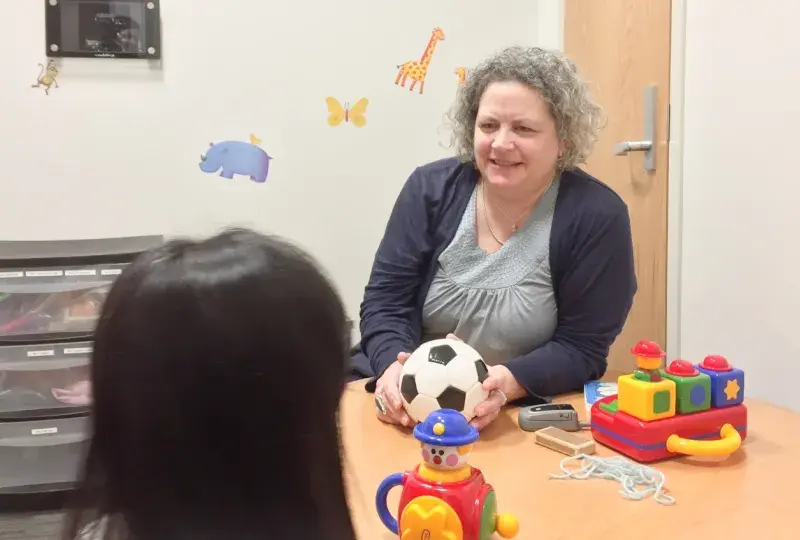
Karen Chenausky is an associate professor and director of the Speech in Autism and Neurodevelopmental Disorders (SPAN) Lab at MGH Institute of Health Professions. She teaches graduate courses on pediatric speech sound disorders and autism. Her researhc seeks to understand why so many children with genetic and neurodevelopment disorders do not acquire spoken language on their own, how we can identify these children earlier, and how we can maximize their communicative potential.
Dr. Chenausky has worked as a speech scientist performing acoustic analyses of typical, accented, dysarthric, and developing speech. She has also worked clinically in private practice and for local school districts as a speech pathologist, running social skills groups with verbal children and teens with autism and related disorders. Her work has been supported by the National Institutes of Health, the American Speech-Language-Hearing Foundation, Autism Science Foundation, Autism Speaks, Simons Searchlight, and the Tufts Clinical and Translational Science Institute.
- SB, Linguistics and Philosophy, MIT
- MA, Linguistics, University of Connecticut
- MS, Speech Pathology, Boston University
- PhD, Speech, Language, and Hearing Sciences, Boston University
Dr. Chenausky employs perceptual, acoustic, and kinematic methods to study spoken language development in children with communication disorders.
Dr. Chenausky has published numerous papers - some titles are highlighted below. You can view a complete listing of Dr. Chenausky's publications on Google Scholar or in her CV.
We rigorously demonstrated the presence of a co-occurring motor speech disorder, Childhood Apraxia of Speech, in at least a quarter of minimally verbal autistic children and showed that CAS was related to expressive language skill in this population.
Factor analysis of signs of childhood apraxia of speech. Journal of Communication Disorders.
Our work supports the validity of the three main diagnostic criteria for CAS from the American Speech-Language-Hearing Association.
Using computational models of speech development, we showed that some minimally verbal autistic children with CAS may also experience challenges in speech perception that affect their ability to produce clear, comprehensible speech.
We have pioneered rigorous, respectful methods for assessing and investigating spoken language in children with severe communication challenges.
Those methods provide vital information on phenotypic variation in spoken language acquisition across genetic and neurodevelopmental disorders, which is crucial for identifying the genetic and brain bases of expressive language impairment.
In addition, Dr. Chenausky regularly presents at conferences and industry events. Please see her CV for a complete list of presentations.
Considerations for Assessment and Treatment for Children with Complex Communication Profiles.” Oral Presentation, Apraxia-Kids Annual Conference 2025.
“Remote, In-Home Assessment of Spoken Language in Low- and Minimally Verbal Autistic Children.” Oral Presentation, International Society for Autism Research 2025
“Touch-Screen Game to Assess Categorial Perception in Minimally Verbal Children with Autism.” Oral presentation, American Speech-Language-Hearing Association 2023
“Speech Ability Affects Expressive Language in Minimally Verbal Autistic Children: Remote Replication of In-Person Findings.” Poster presentation, Gatlinburg Conference 2023
“Speech Therapy for Minimally Verbal Autistic Children: Where are we? Where can we go?” Invited presentation, NIDCD Virtual Workshop on Research Directions for Interventions to Promote Language and Communication in Minimally Verbal/Non-Speaking Individuals with Autism 2023