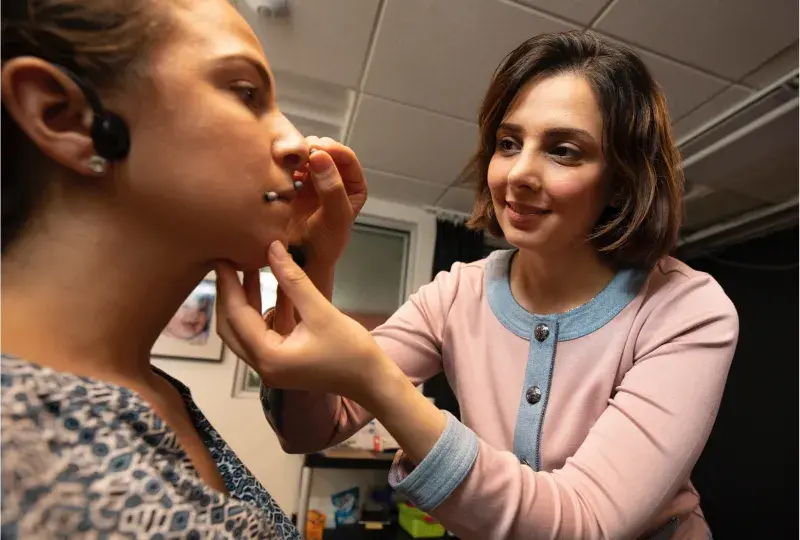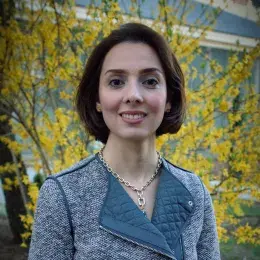
Marziye Eshghi, PhD is an Associate Professor at the MGH Institute of Health Professions and Director of the Speech, Physiology, and Neurobiology of Aging and Dementia (SPaN-AD) Lab. She also holds faculty appointments at the Martinos Center for Biomedical Imaging and the Department of Radiology at Massachusetts General Hospital, Harvard Medical School. Her research has been competitively funded by multiple agencies, including the NIH, the Massachusetts AI and Technology Center (MassAITC), and the American Speech-Language-Hearing Foundation (ASHFoundation). Within this framework, the SPaN-AD Lab provides a multidisciplinary training environment for undergraduate, graduate, doctoral, and postdoctoral scholars pursuing careers in Alzheimer’s disease, dementia, and related neurodegenerative disorders. Dr. Eshghi’s research program focuses on developing non-invasive, speech-based biomarkers for the early detection and monitoring of neurodegenerative diseases. Her work spans Alzheimer’s disease, vascular dementia, Lewy body disease, Parkinson’s disease, and amyotrophic lateral sclerosis (ALS), with the goal of advancing precision diagnostics and personalized interventions.
Dr. Eshghi leads a multimodal program of research that integrates:
Speech analytics and algorithm development: Creation and validation of computational pipelines for acoustic, articulatory, and language feature extraction using advanced natural language processing (NLP), artificial intelligence (AI), and machine learning methods for laboratory and remote monitoring of clinical speech data.
Electrophysiological and neuroimaging techniques: Multimodal recordings (EEG, EMG, kinematic tracking) combined with structural and functional MRI to identify neural signatures of motor and language dysfunction.
Biological and systemic markers: Genetic risk factors, cerebrospinal fluid and plasma biomarkers (e.g., phosphorylated tau, neurofilament light), and vascular and metabolic health variables such as hypertension and diabetes.
Laboratory and real-world monitoring: High-resolution laboratory recordings paired with remote, ecologically valid monitoring of speech and physiology in naturalistic settings, enabling longitudinal tracking of subtle changes across disease progression.
A central theme of her work is within-group phenotyping to capture individual variability in how early disease processes unfold. By fusing molecular, neural, physiological, laboratory, and real-world speech-based data—supported by robust speech analytics pipelines—her research aims to deliver scalable precision diagnostics that identify risk trajectories and enable individualized intervention well before clinical symptoms emerge.
- PhD, Speech and Hearing Sciences, University of North Carolina at Chapel Hill, Chapel Hill, NC
Selected conference and journal publications
Eshghi, M., Rong, P., Mefferd, AS., Stipancic, K.L., Yunusova, Y., Green, J.R. (2019). Reduced task adaptation in alternating motion rate tasks as an early marker of bulbar involvement in amyotrophic lateral sclerosis. Interspeech.
Eshghi, M., Richburg, B., Yunusova, Y., Green, J. R. (2019). Instrumental Evaluation of Velopharyngeal Dysfunction in Amyotrophic Lateral Sclerosis. ICPhS.
Eshghi, M., Adatorwovor, R., Preisser J. S., Zajac, D. J. (in press). Vocabulary Growth from 18 to 24 months of age in Children with Repaired Cleft Palate, Children with Otitis Media, and Children with Typical Development. Journal of Speech, Language, and Hearing Research.
Zajac, D. J., & Eshghi, M. (2017). Vocal Loudness as Contributory to the Occurrence of Obligatory Posterior Nasal Turbulence. The Cleft Palate-Craniofacial Journal, 55(2), 301-306.
Eshghi, M., Vallino, L. D., Baylis, A. L., Preisser, J. S., & Zajac, D. J. (2017). Velopharyngeal Status of Stop Consonants and Vowels Produced by Young Children With and Without Repaired Cleft Palate at 12, 14, and 18 Months of Age: A Preliminary Analysis. Journal of Speech, Language, and Hearing Research, 60: 1467-1476.
Eshghi, M., Alemi, M., & Zajac, D. J. (2016). Aerodynamic and Laryngeal Characteristics of Place-Dependent Voice Onset Time Differences. Folia Phoniatrica et Logopaedica, 68(5), 239-246.