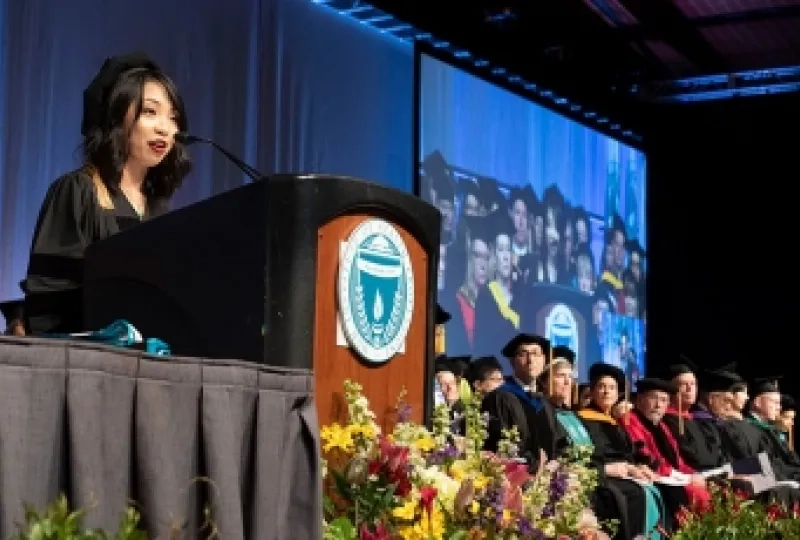
Baothy Huynh, PhD, OTR/L, is an occupational therapist and Assistant Professor in the Department of Occupational Therapy at MGH Institute of Health Professions. She earned her BS in Biology with a minor in Psychology from Loyola University Chicago (2015), her Doctor of Occupational Therapy from the MGH Institute of Health Professions (2019), and completed her PhD in Rehabilitation Sciences in June 2025 under the mentorship of Dr. Teresa J. Kimberley, where her doctoral work investigated intracortical inhibition in focal dystonia using neuromodulation and neuroimaging approaches. She was a 2024-2025 AAUW American Dissertation Fellow.
Dr. Huynh is broadly interested in understanding the pathophysiology underlying neurorecovery and movement disorders. Her research is at the intersection of neuroscience, neurorehabilitation, and data-driven technology, with a focus on multimodal neurophysiological methods, including transcranial magnetic stimulation (TMS) and functional neuroimaging. She is particularly interested in the assessment, measurement, and analysis of neurorecovery data, as well as its potential impact on clinical decision-making and functional outcomes. Her scholarship has been published in journals including Neurorehabilitation and Neural Repair, Movement Disorders, and Brain Stimulation.
- BS Biology, Loyola University Chicago, IL
- Doctorate of Occupational Therapy, MGH Institute of Health Professions
- PhD, Rehabilitation Sciences, MGH Institute of Health Professions
- Neurorehabilitation
- Dystonia
- Stroke
- Transcranial Magnetic Stimulation
- Functional Imaging
Dr. Huynh has published numerous papers - some titles are highlighted below. You can view a complete listing of Dr. Huynh's publications on Google Scholars or in her CV.
Task-dependency of the cerebellar-motor network in adductor laryngeal dystonia.
In addition, Dr. Huynh regularly presents at conferences and industry events. Please see her CV for a complete list of presentations.
Task-Based Functional Imaging in Task-Specific Focal Dystonia during Dystonia-Related and -Unrelated Tasks at the International Parkinson and Movement Disorder Society.
Preliminary network changes in action-specific focal dystonia using individualized cortical parcellation at the Society for Neuroscience.
The relationship of corticospinal tract (CST) measures with hand strength and dexterity after acute stroke at the Annual Mass General Neuroscience Day.
Probing the Inhibitory Motor Circuits in Adductor Laryngeal Dystonia during a Dystonia-Unrelated Finger-Tapping Task at the 6th International Dystonia Symposium.
Sensitivity to change and responsiveness of The Fugl-Meyer Assessment - Upper-Extremity in Individuals with Moderate to Severe Acute Stroke at the Archives of Physical Medicine and Rehabilitation