

Highlighting Interdisciplinary Approaches to Reading Research and Practice
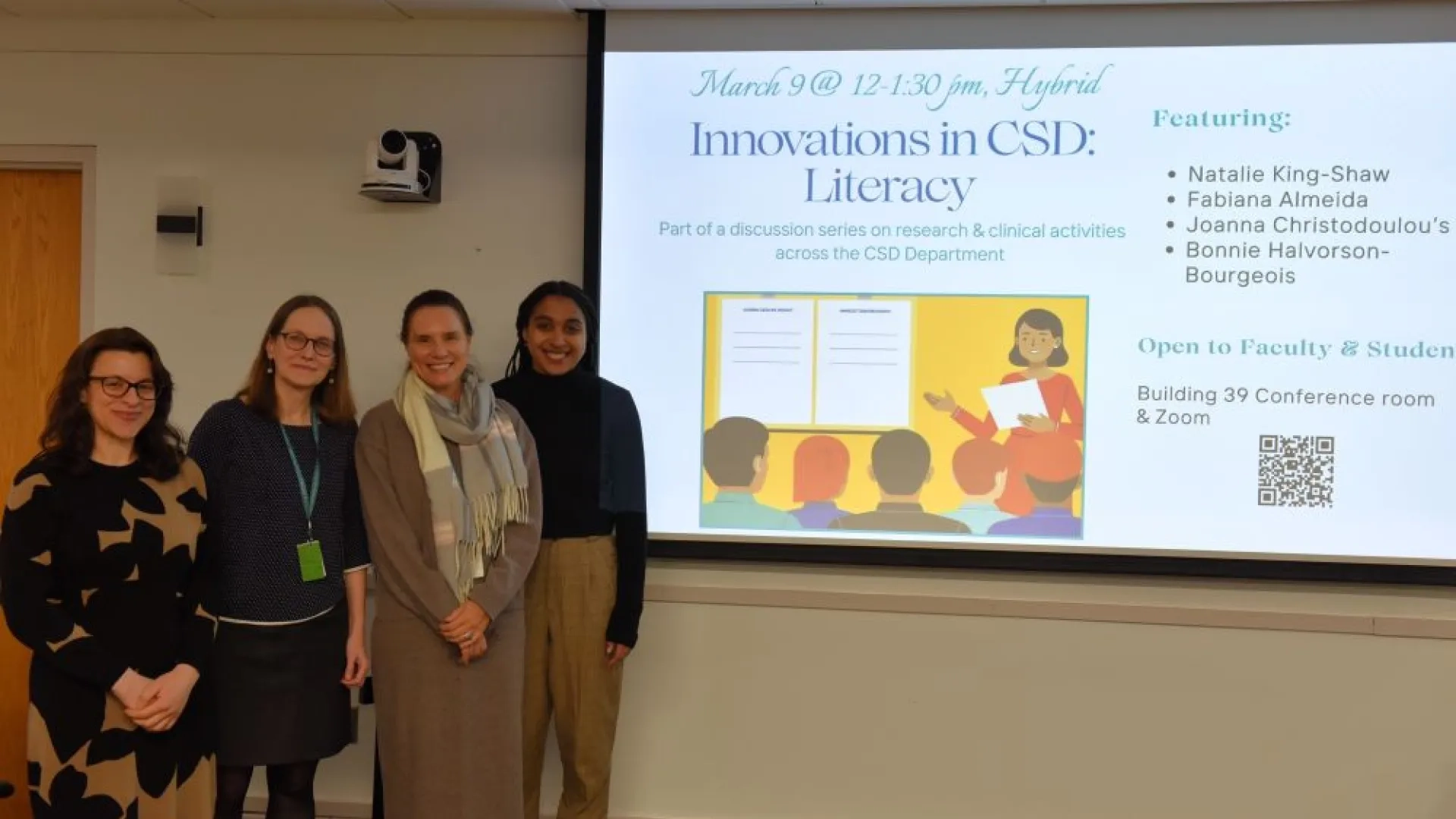


From clinical training to cognitive neuroscience and global research, speakers at the Innovations in CSD: Literacy event showcased how interdisciplinary approaches are shaping the future of literacy. The event brought together PhD student Natalie King-Shaw, visiting research scholar Fabiana Almeida, CSD Professor Joanna Christodoulou, and Assistant Professor Bonnie Halvorson-Bourgeois to explore how research, technology, and clinical practice are advancing literacy as a lifelong and increasingly complex process.
The presentations underscored the shared goal of improving literacy outcomes through more precise, inclusive, and innovative approaches. By integrating clinical practice, research, and emerging technologies, the speakers highlighted how the field continues to evolve to better support learners across populations and stages of life.
King-Shaw presented her project, AMANI Reads, which expands a mentorship-based literacy initiative to support Black elementary students experiencing reading difficulties. Building on a program founded in San Diego, the initiative brings culturally-centered mentorship to Boston by pairing Black community college students with local elementary students for individualized, evidence-based literacy support. King-Shaw said she felt “inspired and energized” by the work of fellow presenters advancing literacy as a human right.
Dr. Almeida's presentation, Literacy Across Languages and Lifespans, she explored how cognitive and metacognitive processes shape reading and writing, particularly in adult education and multilingual contexts in Brazil. She also reflected on how her previous experience at the Institute helped inform her current research trajectory and future questions. “It was a pleasure to return to MGH Institute of Health Professions…and reconnect with colleagues while presenting my current research,” she said, adding that she was grateful for the opportunity to exchange ideas and learn from other presenters.
Dr. Christodoulou focused on improving diagnostic precision in reading. Featuring work from her team in the Brain, Education, and Mind (BEAM) Lab, she highlighted how overlapping conditions, such as ADHD, dyslexia, and executive function challenges, are often misunderstood or underrecognized in educational settings. Her work draws on brain imaging and behavioral research to clarify how these challenges intersect in order to better support students. “We want to empower educators, clinicians, families, and students with this knowledge so that assessment, instruction, and services can be well-allocated,” she said.
Dr. Halvorson-Bourgeois concluded the session by highlighting how literacy is integrated across five clinical practicum opportunities within the Julie Atwood Speech, Language and Literacy Center (SLLC). These programs allow students to work with clients across the lifespan using a range of client-centered literacy intervention approaches, with a strong emphasis on the connection between oral and written language, the integration of technology, and a nationally recognized credential supported by recent International Dyslexia Association reaccreditation. “It was an honor to highlight the integrated ways literacy is targeted in our in-house clinical education within the context of innovation,” said Halvorson-Bourgeois.