

Mentoring the Future
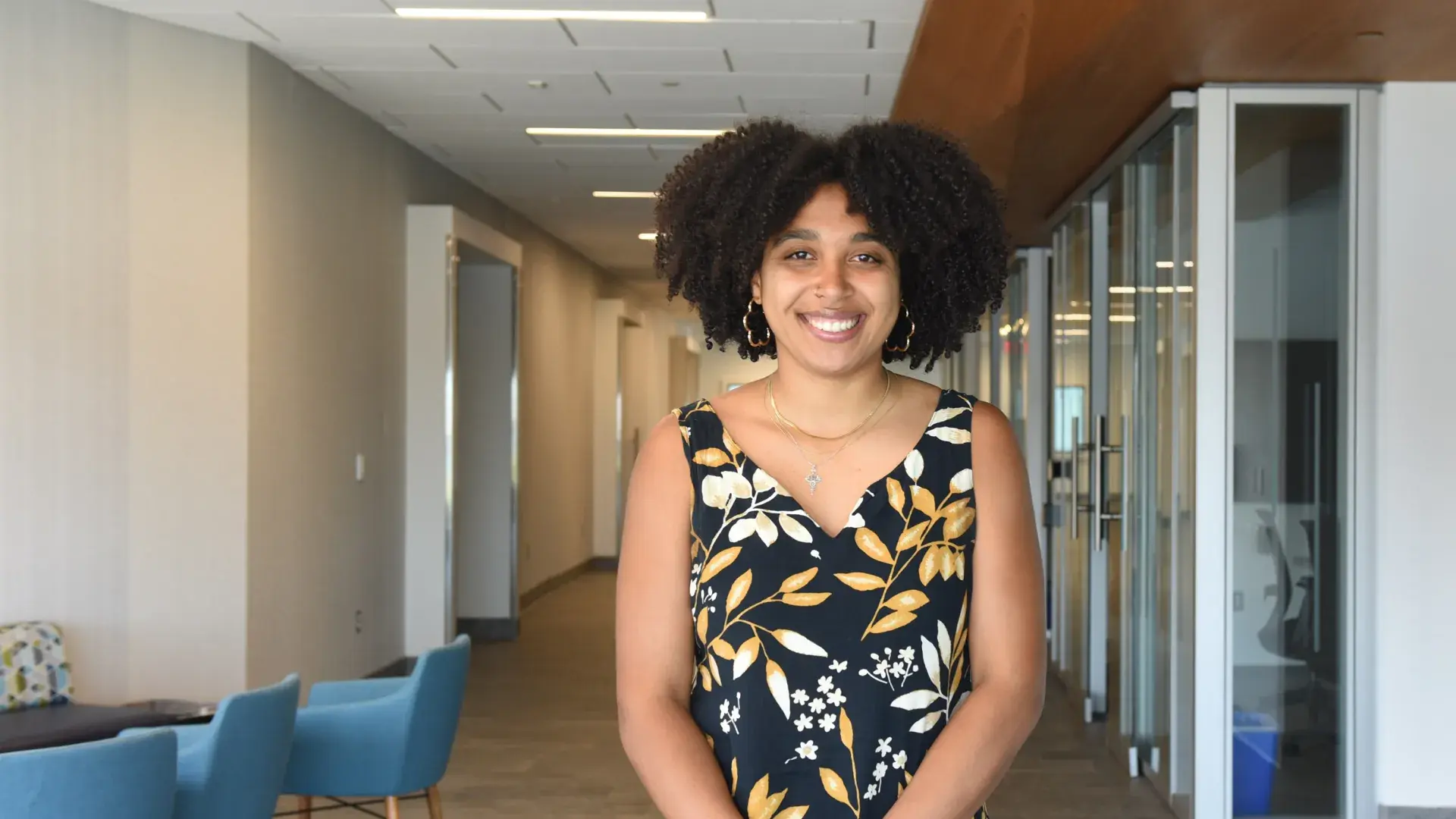


SAiL Literacy Lab Research Fellow Natalie King-Shaw uses experience and passion to create paths to better futures through mentorship
Few people understand the importance of mentoring more than Natalie King-Shaw. A community of mentors has brought her on an unanticipated professional journey that has led to Boston and the MGH Institute and inspired her to work ensure others can enjoy the benefits of a supportive community.
King-Shaw found her community when she took part in a mentorship program as an undergraduate at San Diego State University (SDSU). Run by the SDSU Black Resource Center, it was the first time she had ever been in an all-Black classroom.
“I had never had that kind of community in my education before,” said King-Shaw, who went from being a mentee in the program to working for the Black Resource Center as a mentor in the program. “Throughout that whole experience, I was so glad I had found that community and wished I didn’t have to wait until I was in college to feel that sense of community and representation.”
With the support of Ahliyah Chambers and Donnae Prather, her mentors from the Black Resource Center, Chelsea Lombrozo, her mentor from the SDSU Glazer Center for Leadership and Service, and her undergraduate research advisor, Dr. Sonja Pruitt-Lord, King-Shaw successfully secured funding from the Donald A. Strauss Foundation Scholarship to start the A.M.A.N.I. (Affirming, Mentoring, Actualizing, Nurturing, and Imagining) Project which pairs Black elementary school students in San Diego with SDSU student mentors to support, “a limitless future for young Black scholars.”
A psychology major, King-Shaw took speech language and hearing sciences classes and recognized how language and communication are tied to identity and culture, so she added a second major.
“I feel like this is the work I’ve always wanted to be doing, and it really brought together all of my passions,” said King-Shaw, “It gave me an outlet to give back to the community that had really carried me through my education.”
Because of her experience with the A.M.A.N.I. Project, Dr. Pruitt-Lord brought up the idea of doing that same type of work while pursuing a PhD. While looking into the Harvard Speech, Hearing Bioscience, and Technology (SHBT) doctoral program, which trains researchers in basic science, translational medicine, and engineering approaches to the field of human communication, she connected with MGH Institute’s Sofia Vallila Rohter, Associate Professor in the Department of Communication Sciences and Disorders in the School of Health and Rehabilitation Sciences and Co-Director of the Cognitive Neuroscience Group, who had completed the SHBT program and serves as the SHBT SLP track director. She suggested King-Shaw reach out to Tiffany Hogan, a CSD professor and Director of the Speech and Language (SAiL) Literacy Lab.
Hogan’s work proved to be a good fit for King-Shaw, who enrolled in the Harvard program, became a doctoral research fellow in the SAiL Literacy Lab, and is doing her clinical training at the MGH Institute through the Master of Science in Speech Language Pathology program.
“I came to work with Tiffany because I really wanted to learn about school-based implementation science to figure out how we could continue to expand programs like A.M.A.N.I. to really support Black students and historically underrepresented students through community-based practice,” explained King-Shaw. “As I joined the lab, I really started learning about literacy access and the disparities, especially racial disparities, in literacy rates and literacy access. The more I learned, the more I began thinking about literacy as a human right and a social justice tool.”
As she is learning and supporting projects in the lab, King-Shaw is still focused on building community through the A.M.A.N.I. Project.
“Natalie is stellar,” said Hogan. “She is an exceptional student who comes with a ton of experiences and had already developed the A.M.A.N.I. program so she's been learning about experimental and implementation science methodology. She's been collecting some data for our projects and developing measures. She has immersed herself in the lab so she can learn skills and apply them to the A.M.A.N.I Project.”
King-Shaw is working to bring A.M.A.N.I. to Boston with a focus on the work she is doing in the SAiL Lab. She has received support from SAiL Lab funding from RSM, which funds community programs in Charlestown, and facilitated a connection with the Boys & Girls Club in Charlestown. After learning that there was a need for more literacy support for local youth, she connected with Bunker Hill Community College through IHP President Paula Milone-Nuzzo to have some of its students serve as mentors for A.M.A.N.I. Reads, which uses community-based mentorship to engage Black students and address barriers to access for literacy services and support.
“Natalie has been exceptional and outstanding in pulling those partnerships together,” noted Hogan. “She's the driving force that's making those connections, scheduling the meetings with me, and pulling in Paula [MGH Institute President Paula Milone-Nuzzo].”
The project is rolling out in stages with the mentors getting to know the children and building trust and understanding before bringing in the literacy component this fall. The mentors will work with students from the 5th to 7th grades, an important age group for addressing literacy issues.
“Schools don’t always have the resources, support, and training to give evidence-based literacy instruction and that creates huge access and equity gaps,” said King-Shaw. “Theres a shift in learning to read and reading to learn around 3rd or 4th grade. As students get older, if they are having reading difficulties and not receiving support, there can be huge implications for opportunities and experiences downstream as well as for dropout rates. Education can’t engage all students if we are not taking into account the different factors and barriers that are in place for students.”
Through A.M.A.N.I. Reads, King-Shaw hopes that matching mentors who understand the experiences the young students might be encountering can provide a supportive community that allows students to thrive and feel seen in their educational journeys, similar to the support she received during her own educational journey.
Do you have a story the Office of Strategic Communications should know about? If so, let us know.