

Unsilenced by Aphasia
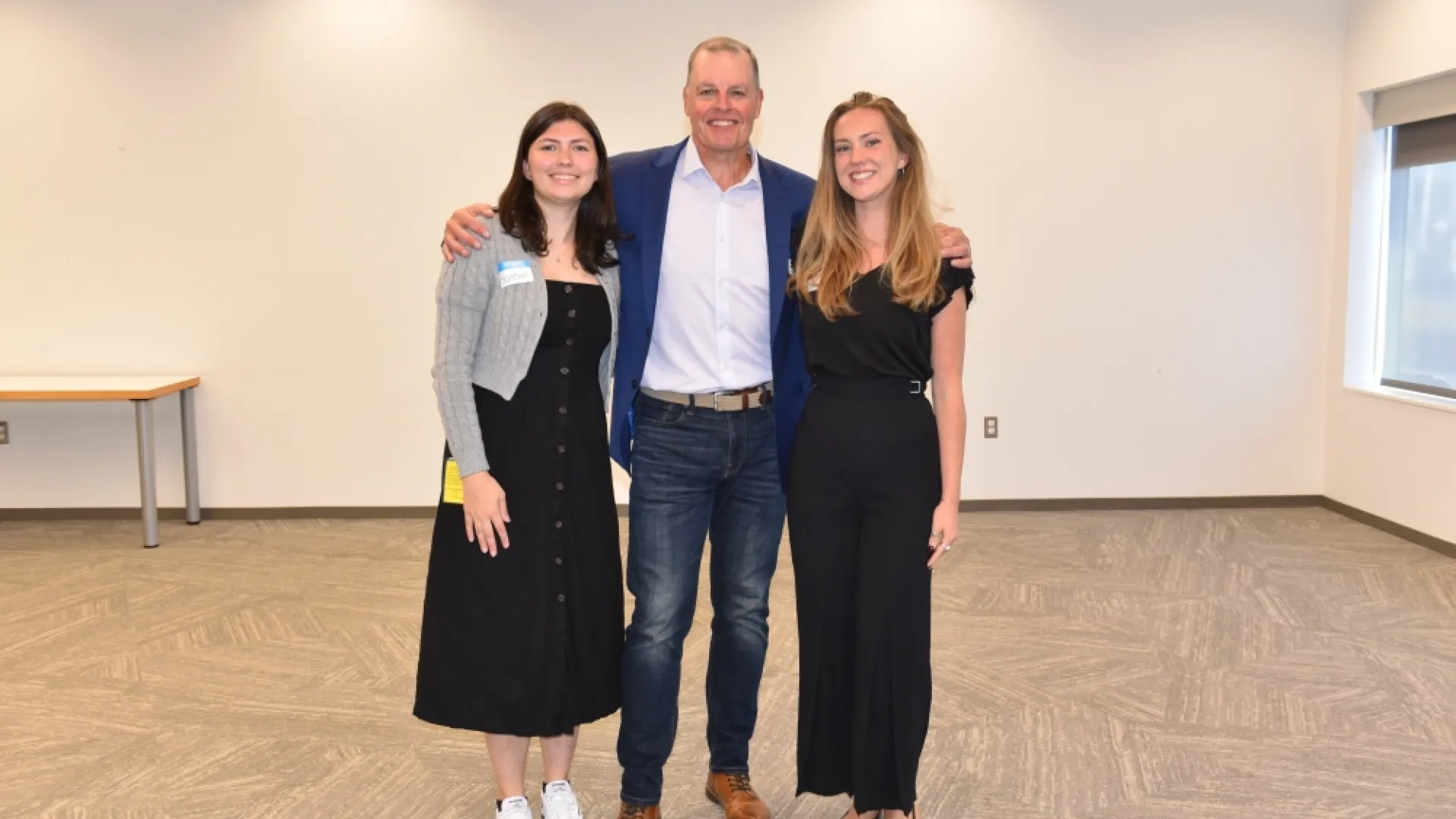


S-IHP’s CAP participant Roy Grafton takes on aphasia challenges
Roy Grafton sat in a room in 2CW on the MGH Institute of Health Professions campus and made a phone call. Talking on the phone is something he used to do frequently for his job, but after having a stroke in January 2024, phone calls were few and far between. That has changed.
The phone call he was making was to a fellow participant in the comprehensive aphasia program called S-IHP’s CAP, a collaboration between Spaulding Rehabilitation Hospital and the MGH Institute of Health Professions. Aphasia is a disorder that can affect one’s ability to speak, write, and understand both written and spoken words. Each of the nine participants in this year’s S-IHP’s CAP program took part in the intensive, six-week program to work on individual goals with occupational therapy and speech language pathology students from the MGH Institute in one-on-one and group sessions, as well music therapy, swimming, wellness, and adaptive sports with professionals from Spaulding.
Each client has different challenges. Since the stroke, Grafton has been dealing with the effects of a type of aphasia called conduction aphasia.
“Basically, I don’t understand what you are saying,” explained Grafton, who will at times ask people to rephrase what they have said so that he can understand what they are trying to say.
That can make talking on the phone difficult, so he didn’t make many calls after his stroke. During the occupational therapy assessment at the beginning of the program, that was one of the goals he chose to focus on during his sessions with third-year OT student Samantha Fitzgerald.
“When Roy first started the program, we talked through every possible daily activity, and he narrowed down five areas that he really wanted to work on during this program — things that felt meaningful to him or had been impacted by his stroke,” said Fitzgerald. “Two of his activity areas were talking on the phone and getting back into volunteer work. Knowing his interest in adaptive sports, we used that as the focus for a simulated volunteer inquiry phone call, where I played the role of a volunteer coordinator. It gave him a chance to practice real-world communication and build confidence in a supportive setting and he did great!”
That work paid off and with a week and a half left in the program, Grafton shared that he had already made 25 phone calls to family and friends, not including that call he made from the room in 2CW to another participant in the program. That was part of a group exercise done on ‘Tech Tuesday’ where participants downloaded WhatsApp and used it to communicate with the other person. Tech Tuesdays are a day where group exercises are focused on a certain area. Another was Food Friday where the group made meals. But cooking was about more than just preparing something to eat.
“Cooking is a huge cognitive challenge,” said Mary Hildebrand, OTD, OTR/L, FAOTA, associate professor emeritus and founding director of the Institute’s Tabor-Connor Family Occupational Therapy Center for Learning, Participation, and Rehabilitation (OT CLiPR). “It helps people work on a number of skills. You have to read and follow the recipe. There is math if you have to double to recipe. We also make a plan for the next week and have a participant order what we will need, and some must learn to use adaptive kitchen equipment.”
Cooking was a way for Grafton practice following instructions, something he also worked on through a challenging exercise with speech pathology student Hannah Indiviglio.
“One of Roy's goals is to work on understanding verbal instructions with multiple parts,” said Indiviglio. “We used circuit boards to work on auditory comprehension. I gave him specific directions out loud that he had to follow in order to correctly build the circuit.”
“We put pieces together in the circuitry to make it work,” said Grafton. “Basically, ‘place the blue wire with three snaps from A5 to C5 to the right of the green switch.’ For most people, it seems simple, but it is really hard. When we put it together it works so if we are successful, we make what I call a gizmo.”
Grafton started with simple instructions and progressed to being able to understand more complex instructions to make the gizmo. He also wrote in his journal every day, asking Indivigio for words of the day. Slowly, he got better at finding the words, articulating his thoughts, and writing sentences.
Family and friends marveled at Grafton’s improvement as he went through the program, and his hard work was evident to everyone who worked with him.
“Roy was motivated throughout the entire experience.” Said Indiviglio. “He arrived at session every day ready to work on skills that are challenging and remained positive and motivated. It was such a pleasure working with him.”
S-IHP’s CAP also connected Grafton, a husband and father, with the other eight participants, who bonded over their shared experiences, appreciated the differences in their challenges, and helped each other throughout the program. He considers them his brothers-in arms.
“We’re all different, but we are the same,” Grafton reflected during a presentation at the program’s graduation ceremony last Friday. “We all have our own struggles and frustration with aphasia. However, keep improving. Practice, practice and piece by piece we will get there. Never give up.”
“Throughout this program, Roy showed such patience, determination, and care for the people around him,” said Fitzgerald. “Watching him encourage others and reflect on his own growth has been one of the most rewarding parts of this experience. It was such an honor to work with him.”
He also shared some thoughts he had written in his journal during the program for others with aphasia.
“You cannot keep your ideas, questions, and dreams in your head,” advised Grafton. “You have to express them. One of my words of the day was idiom and one of those in business is being seated at the table. Aphasia survivors must have a seat at the table. Furthermore, you must have a voice at the table.”
Do you have a story the Office of Strategic Communications should know about? If so, let us know.