

The IHP Interview: Kathy Lyons on Strength After Breast Cancer
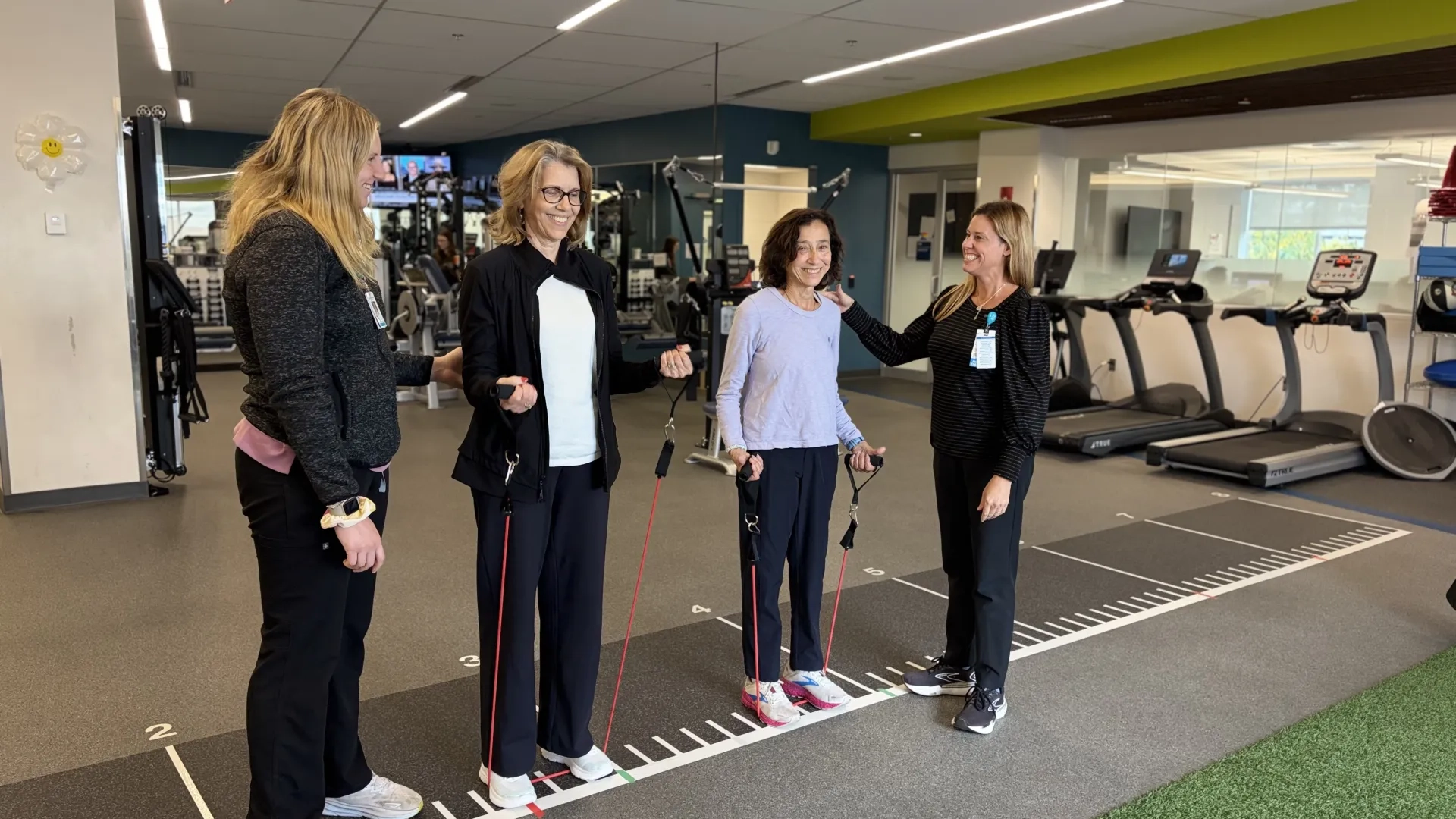


In recognition of Breast Cancer Awareness Month in October, the OSC’s Sean Hennessey sat down with Kathy Lyons, director of the Cancer Rehabilitation (CaRe) Lab at the MGH Institute of Health Professions to talk about the implementation of group exercise and the barriers she and her team are helping clinicians overcome. Their conversation has been edited for brevity and clarity.
Before we get to your research, let’s start with Strength after Breast Cancer - what is it?
Strength after Breast Cancer (SABC) was the result of a series of studies led by Dr. Kathryn Schmitz at the University of Pittsburg’s Hillman Cancer Center. Those studies showed that supervised strength training is an important part of recovery after breast cancer surgery. SABC focuses on building arm strength, regaining or maintaining range of motion, and making sure people understand how to reduce the risk of lymphedema after breast cancer surgery.
It’s widely accepted that when survivors are in a group, they’re even more apt to exercise. But getting survivors in one room isn’t as easy as it sounds. Tell us about that.
We know that when breast cancer survivors are in a group, the social support and camaraderie can lead to better outcomes. But offering group sessions in a clinic or hospital setting presents challenges. You need enough space in a gym to accommodate multiple people doing the same exercises, you need to understand how to bill for group visits, you need enough people at a similar level of function to run the group, but not so many referrals that there’s a long waiting list that discourages people. It’s all just a little more complicated for clinics that are used to providing individual therapy sessions.
Physical therapists from the Massachusetts General Hospital clinic in Waltham decided to deliver SABC in a group setting. That’s where you and researcher and term lecturer Stephen Wechsler come in.
Yes, Steve and I said, “If you're going to implement this, can we build an implementation study around it, and look at what works well and what you might have to adapt?” Any evidence-based program needs a little tailoring in any particular environment. The clinicians were really excited about the idea of building this into a research study so that others could learn from our experience of implementing this evidence-based program. It’s been this wonderful match made in heaven for Steve and me to work with MGB physical therapists, Allison Snyder and Cheryl Brunelle, and oncologist Amy Comander.
And it’s led to some impactful research. You and Professor Wechsler were authors on the paper, “Implementation of a Group Exercise Program for Survivors of Breast Cancer: feasibility, Acceptability, and Adaptations” that was published by the American College of Sports Medicine. What were the results?
As expected, we made some modifications to the group exercise approach. For example, we added a session in response to patient and clinician feedback. And one of our entry-level doctoral students noticed that the breast cancer survivors were getting a lot of verbal information, but no handout to take home with them to help them remember. So, we created an orientation packet as well.
We went back to the Strength After Breast Cancer developer, Dr. Schmitz, and said, “Hey, we love your program, but we've made these adjustments to it. Have we shifted this so that you as the developer would say that's not Strength After Breast Cancer anymore, or is this still acceptable? How do you feel about this?” Because that's one of the things in implementation science we talk about: is the modification fidelity consistent? Meaning, is it still in the spirit of the program, or is fidelity inconsistent, meaning it changes it somehow? And we used to think, “Oh, all change is bad, it can only water down the intervention,” but now we know in implementation science, when you put it out in the real world, practicing clinicians have good ideas. They can make it better and stronger. Dr. Schmitz looked at what our modifications and said, “Yes, that's in the spirit of the program.”
So, you produced the paper on the modifications, and you’re not stopping there.
Correct. We’re working with physical therapists in Atlanta, Georgia and with physical therapists at MGH Chelsea to implement the program. We conducted a focus group in Atlanta, and we're conducting a focus group in Chelsea next month. We’ll be talking to the front desk people, the nurse navigators, clients, and the therapists who are going to lead the program. We want to ask them, how will it fit? What should we adapt going forward, besides translating the materials into Spanish? What else should we know? How else should we tailor the message so that people will want to take part in it? We want to take what we learned in Waltham and help the two clinics find ways to make SABC work in their practices.
You have found that the group exercise among breast cancer survivors has turned into a quasi-support group, right?
Yes, there a psychosocial benefit that they get with each other. It’s nice because some people wouldn't go to a support group, because they'd think, “Look, I don't want to sit around talking about stuff, I've had enough of that.” But the vehicle here is exercise, and we’re focusing on something you can control. So much of cancer treatment is, “Buckle up, you'll be getting this next.” Oncology treatments are done to you. Radiation is given to you. Chemotherapy is given to you. Surgery is done while you're asleep.
This is flipping that switch — this is one thing you have control over. It's like your personal medicine of being able to do something that reclaims strength and movement. And that is a strong message, and it innately inspires sharing of other things survivors have found that help them cope and thrive after cancer treatment.
While the idea for group exercise came from the clinicians at MGH Waltham, the MGH Institute’s involvement brought more structure to the implementation, along with a way to track what’s happening.
I’d say that’s a fair assessment. We brought structure to monitor whether it's working or not. Some of these things are captured in the medical record, but others aren’t. For example, to get this off the ground, we need to know, “How many people did you have to invite? How many doctors did you talk to about it? How many referrals did you get? How many ended up doing it?” We put a little structure around it to try to help measure that, and to try to be able to say, “Yep, we'll help you track the outcomes, we'll help describe that, so that we can go back to the managers and say, after a year and a half — is it working? Is it worth the effort that we're putting into it?”
I want to emphasize the PTs are doing the heavy lifting there. They got the approval, the buy-in from their clinic; they did the hard part. We came around the back and said, “Can we collect some data so that we can see what's happening and how we can help other clinics to do this?”
And so that raises the next question of what is the next step?
For Strength After Breast Cancer, the group classes at MGH Waltham are continuing, and we’ll be starting a group class in Chelsea after we do preparatory focus groups. And Atlanta just enrolled their first participant.
We want to collect more data and apply for a grant where we can say, “We have a toolkit now, we know how to implement, we know how to talk to the clinics and help them know what they have to prepare for to be ready to do this. We have a procedure for that. Can we do this on a larger scale?”
With a bigger number of sites, you could test different implementation strategies; is the toolkit enough? Do clinic staff need technical assistance to brainstorm practical challenges? What things do we need to support so that it could be opened and sustained at other places? And so, the outcomes would be things like reach, adoption; if we open it at a certain clinic, how many people want it? How many therapists do you need to train up so that it can be sustained? It's looking at, “Can this live in the real world, and actually get to more patients and cancer survivors?”
The goal is to come up with a standardized toolkit so that more people have access to it, so that any clinic who wants to offer group Strength After Breast Cancer knows what it will take as opposed to thinking, “That sounds great, but I don't know how we'd do that. Let's just keep doing what we do well.”
We know how to do the groups, we know what the exercises are, we know the dose of the exercise, we know the sequence we should teach people. There's some room to improve. For example, how do you get people to do the homework and sustain it? But what we don't know is how to make this as easy as possible for clinics who want to say, “Oh, I'd love to offer something better for my patients.”
It all comes back the MGH Institute’s place in the Mass General Brigham ecosystem as a valuable research partner.
It does. There are all these fantastic clinicians at MGB; we can do these really nice partnerships between what's happening in the real world, and then building some research around it, as opposed to just, “Well, we sit in the ivory tower and we do our thing, and they're out in the clinic, and they do their thing,” and we never talk to each other. There's evidence we want to push from the ivory tower into practice, but then there's also practice-based evidence that the ivory tower wants to learn from, so I think that's what we're trying to build — this lovely marriage. As an example, there was a recent conversation with Spaulding, unrelated to Strength After Breast Cancer, where they said, “We did a QI project, where do we go from here? What could we do next?” Now we're having conversations about what could we do next, how we could tell the world what they’re doing, how can we apply for grants to answer different questions.
You just have to be in the room, and amazing stuff is happening throughout MGB. A lot of it is just really good clinical service; maybe we're not publishing on it, maybe we're not studying it, we're just assuming good clinicians give good service. And now we have an opportunity — clinicians are eager to partner on research, and that's awesome.