

First Atwood Drake Family Symposium on Aging and Health Equity Highlights Importance of Evidence-Based Interprofessional Care for Older Adults


Healthcare providers recognize that children need specialized care but are less aware of the unique health needs of older adults. The West Health Accelerator at Mass General Brigham is working to change that and create a healthcare system that raises the standard of care for older adults.
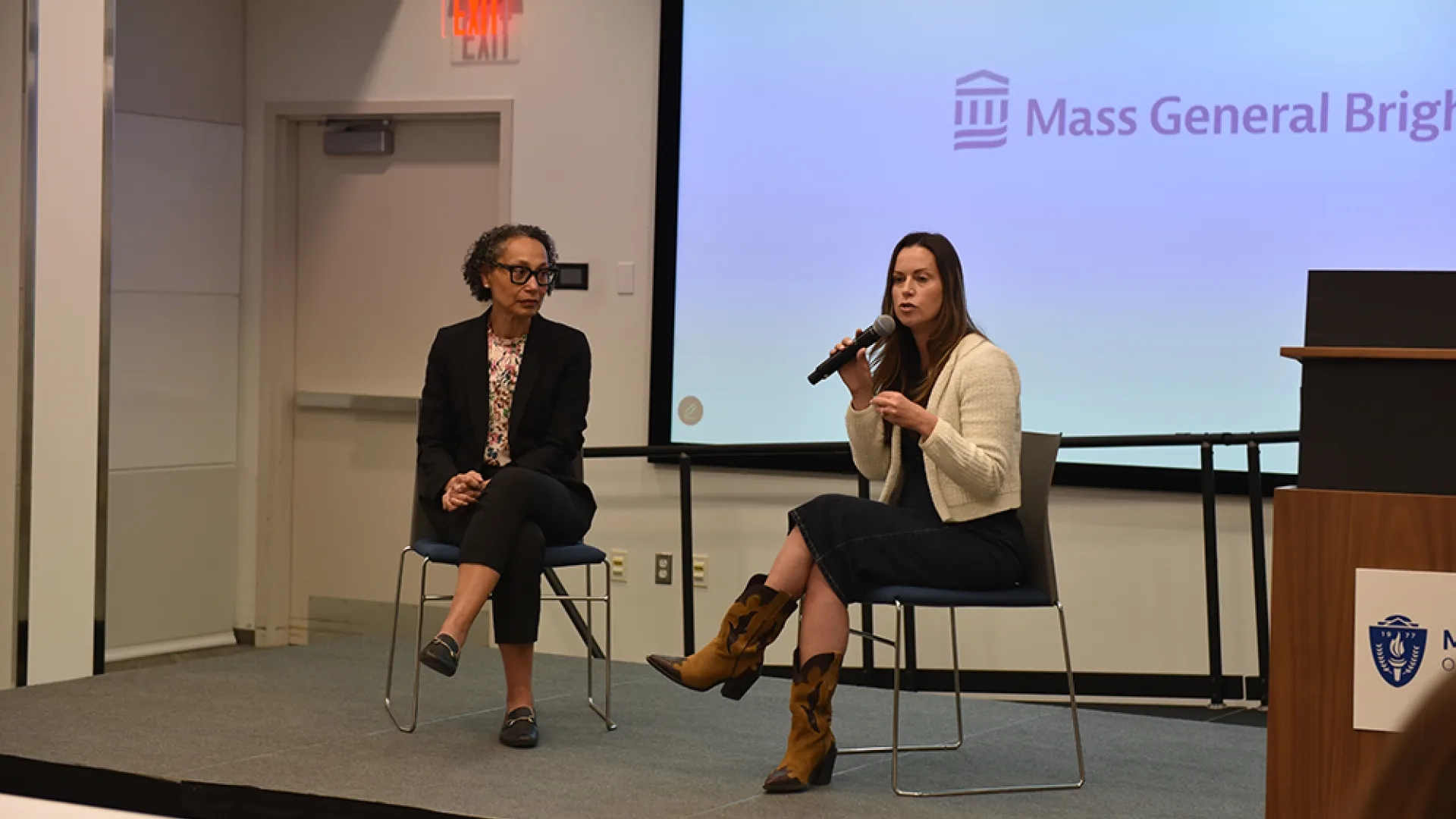
Last Thursday at the Atwood Drake Family Symposium on Aging and Health Equity, a newly established interprofessional lecture series examining the delivery of equitable, high-quality care for older adults, the MGH Institute hosted Principal Investigator and Co-Director of the West Health Accelerator at Mass General Brigham, Dr. Zara Cooper, and the Clinical Director of West Health Accelerator, Renee Tyska in a talk titled, From Innovation to Impact: Interdisciplinary by Design.
Dr. Cooper discussed how older adults often need different medication doses and how receiving care from an order set that is not designed for an older person can lead to delirium, which is associated with cognitive issues. This can lead to spending additional days in the hospital and functional decline. Evidence-based geriatric care can reduce length of stay and cost, while improving client outcomes.
Tyska, a nurse leader, discussed how the West Health Accelerator is implementing changes to reflect that evidence-based geriatric care. While it is just the second year of their work, they have worked on triggers in EPIC to make age-specific care the default and embedding interdisciplinary teams into the system.
The importance of the interdisciplinary teams resonated with the audience, both those in attendance and those who joined virtually.
"What a fabulous inaugural Atwood Drake Family Symposium on Aging and Health Equity,” said MGH Institute Associate Provost and Dean for Interprofessional Education and Practice Dr. Regina Doherty. “Dr. Cooper and Renee Tyska highlighted the critical role of interprofessional collaboration and innovation in raising the standard of care for older adults. The impact of the West Health Accelerator at MGB on patient outcomes in its first year is truly remarkable. Our students, faculty, and staff benefited greatly from hearing first-hand how empowered interprofessional teams — thinking innovatively, scaling clinical innovations, and leveraging change — can advance patient-centered care across health care delivery systems.”
The Atwood Drake Family Symposium will be an annual interprofessional lecture series examining the delivery of equitable, high-quality care for older adults. Co-coordinated by the Center for Interprofessional Education and Practice and the Office of Mission, Values, and Community Excellence, the symposium emphasizes the physical, emotional, and psychosocial needs of aging patients, as well as broader systemic issues such as access, advocacy, mobility, mentation, and care equity across underserved communities. Named for MGH Institute faculty emerita Julie Atwood Drake, the goal of this symposium is to engage the MGH Institute learning community in conversation on best practices in the delivery of quality care for older adults with a focus on health equity.
“The extraordinary vision, leadership, and generosity of MGH Institute faculty Julie Atwood Drake have been foundational to the MGH Institute since its earliest days, and her impact continues to shape our community in profound ways,” said MGH Institute Executive Director of Development Meagan Sheffield. “Through her support of the Atwood Drake Family Symposium on Aging and Health Equity, she is advancing critical conversations around equitable, high-quality care for older adults while inspiring the next generation of health professionals. We are deeply grateful for her enduring commitment to education, mentorship, and innovation in healthcare.”
Jasmine Liu MS-SLP ’26 served as the Health Equity and Leadership (HEAL) Fellow for the symposium. She was motivated to focus on it because she saw the challenges her grandmother faced in navigating healthcare services while facing significant language barriers.
“It was challenging to see how these barriers impacted her ability to fully participate in and make decisions about her own care,” said Liu. “As a HEAL fellow, I saw the Atwood Drake Symposium as a meaningful opportunity to explore how healthcare systems support aging populations, particularly at the intersection of health equity factors, and contribute to conversations around more equitable and accessible care.”