

A Dream Opportunity
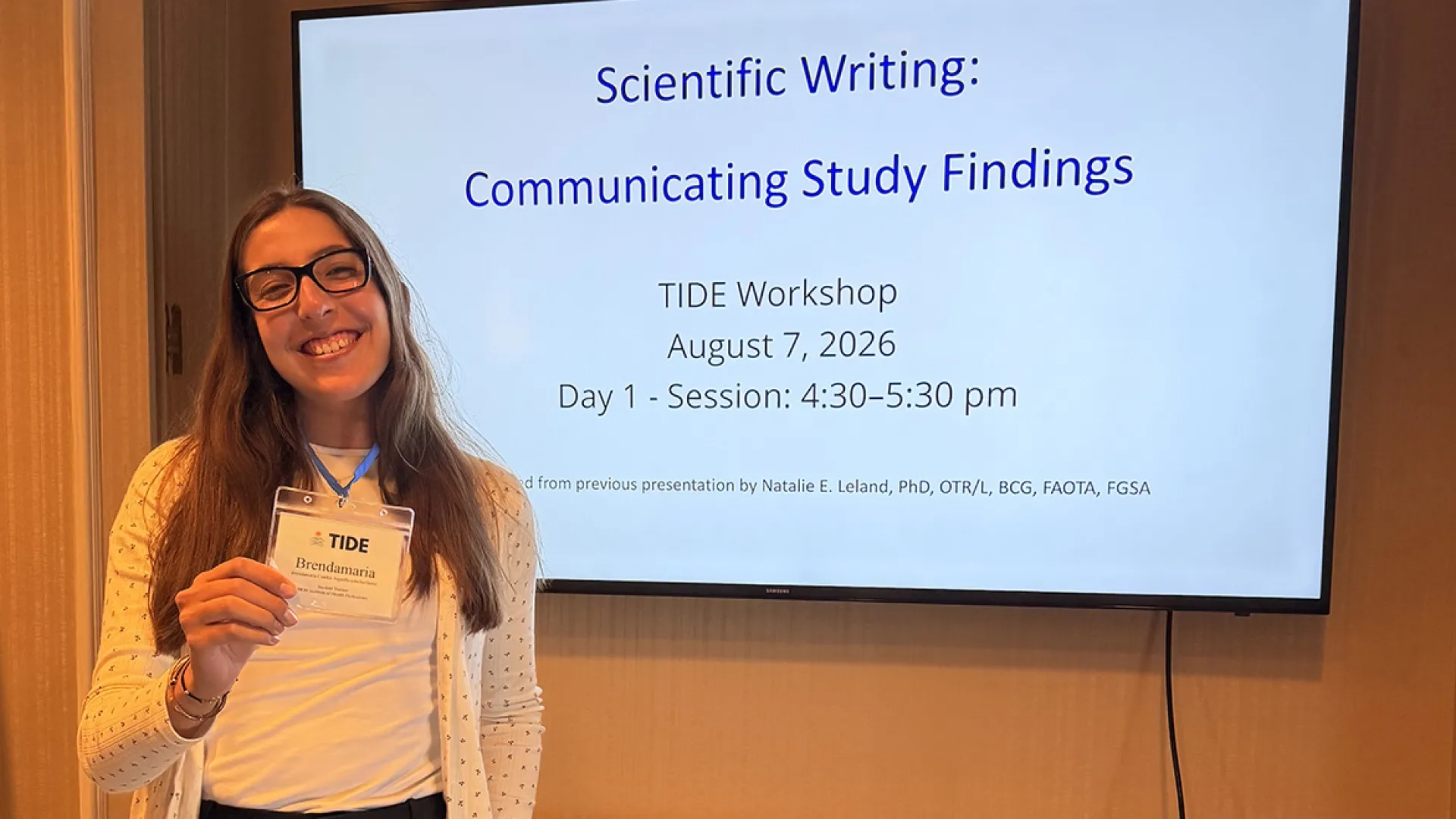


Brendamaria Cuadra-Arguello Selected as One of Six National TIDE Trainees
Brendamaria Cuadra-Arguello never dreamed of a future in research.
"If you told me when I started my undergraduate studies at Lehigh that I would become a researcher, I would've laughed,” said the third-year occupational therapy student. "At that moment, analyzing data sounded like my biggest nightmare," she says.
That opinion has changed, and now she is one of six trainees nationally selected for the Training in Diversity for Rehabilitation Research Education (TIDE) program, a two-year training initiative that pairs early-career clinician-scientists with mentors established in their field. As she begins her final year in the MGH Institute OTD program, Cuadra-Arguello is well on her way to making meaningful contributions to the future of occupational therapy that connects rigorous science with compassionate, community-centered care.
A Drive for Representation
Cuadra-Arguello's interest in research bloomed through different opportunities in psychology and cognitive science at Lehigh, which led her to focus her honors thesis on how children learn and process information. But the motivation and inspiration to keep building on these skills is rooted deeper in her background as a Nicaraguan woman.
“I’ve come to realize that representation in healthcare isn’t only about who provides care; it’s about who asks the research questions,” said Cuadra-Arguello. “If our communities aren’t represented in research, they’re less likely to be represented in the evidence that shapes clinical practice.”
This realization became the driving force of her research. She strives to represent lived experiences like her own to create evidence-based care that is accessible, culturally responsive, and informed by its community.
Finding Community through Mentorship
The MGH Institute provided the mentors and foundation for that integrated research, teaching Cuadra-Arguello a strong appreciation for the interprofessional relationship between the worlds of research and clinical reasoning. Faculty members such as Dr. Pooja Jethani, Dr. Kimberly Erler, and Dr. Kathy Lyons challenged her to think outside the box.
“I’ve learned to constantly ask not only whether an intervention works, but why it works, for whom it works, and whether it truly reflects the needs of the person sitting in front of me,” Cuadra-Arguello said. “That mindset has shaped the way I approach both patient care and research”
While the MGH Institute OTD program provided her with an “outstanding clinical foundation” and chances to gain new perspectives, like the service trip she and her classmates took to Ghana, she was inspired to further expand her research knowledge.
After learning about the American Occupational Therapy Foundation/ American Occupational Therapy Association’s (AOTF/AOTA) Institute of Future Scientists in Occupational Therapy program, she was determined to take part. The program matched potential student scientists with post-doctoral and doctoral mentors, which she believed could help her gain mentorship, connect with peers who may have similar aspirations, and more clearly envision what a career as an occupational therapy scientist may truly look like for her.
This opportunity reassured her that there is a place for someone with her interests and background. “The AOTF Institute exceeded every expectation I had.”
There were endless opportunities while she was in Anaheim for AOTF: Breakfast with a Scholar, the Research Excellence Symposium, and the State of the Science sessions, where Cuadra-Arguello and other attendees heard directly from leaders shaping the future of occupational therapy research. It also covered topics like launching your own research career, community-engaged and anti-ableist research, and plenty of opportunities to connect with mentors at every stage of their careers.
A National Opportunity
Her next chapter is sure to be an unforgettable achievement: the TIDE program. Cuadra-Arguello will spend her two-year mentorship with Dr. Emily Kringle, a researcher with whom she began her relationship at the AOTF Institute.
Being selected as one of only six student trainees nationally was one of the most meaningful moments of her career so far.
"It felt like validation that the research questions I've been passionate about and the work I've intentionally pursued truly have a place within rehabilitation science."
She is looking forward to joining a network of peers and mentors who share the same commitment to community-engaged research and watching how these relationships will shape her career in and out of the program.
“TIDE represents exactly the kind of research community I’ve been searching for."
Continuing the Dream
A few years ago, she couldn't have imagined the important role research would play in her life. Now she can't imagine her professional future without it.
“Long-term, my dream is to use research as a bridge between science and service,” Cuadra-Arguello says. “Whether that work ultimately takes place in the United States, Nicaragua, or ideally both, I want to ensure the research I conduct is grounded in lived experience and produces findings that can directly improve clinical care.”
In Nicaragua, where Cuadra-Arguello hopes to help expand access to rehabilitation services one day, there are currently no occupational therapists. Through both research and clinical practice, she hopes to help change that reality while improving care for underserved communities.
“I hope my work helps create space for future clinicians, scientists, and patients from backgrounds like mine to see themselves represented in both the profession and the research that guides it,” she says.