

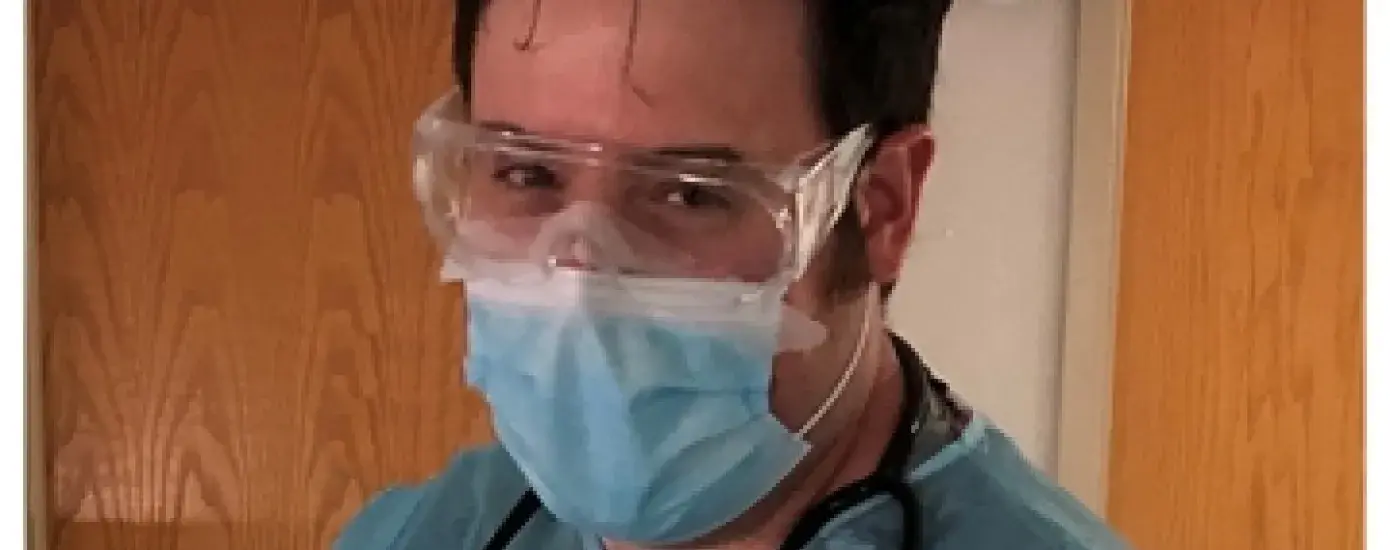


The homeless are among the most vulnerable populations and a community that is among the most susceptible to contracting COVID-19. Harrison Keyes is making sure they are receiving the same care as the rest of Boston’s population.
Keyes, who graduated from the MGH Institute in 2018 with a Master of Physician Assistant Studies degree, oversees a coronavirus testing program for Boston Home Care for the Homeless Program (BHCHP) that identifies homeless individuals who may have contracted the deadly virus.
The city’s largest homeless organization cares for more than 11,000 people each year, meaning there is certainly enough need for Keyes’ commitment. “This type of work can wear on you sometimes,” he readily admitted, “but I do this because it is worthwhile.”
When he isn’t checking patient temperatures or helping coordinate the tests, he spends two nights a week seeing patients at the Southampton Street Shelter, the largest men’s shelter in Boston. In addition, he also works at the respite program at the Barbara McInnis House, a 106-bed facility in the city’s South End where the homeless can recover following hospitalization.
This is not Keyes’ first time working with the underserved. As a 13-year-old, he started volunteering in a program at New England Disabled Sports, designed to help individuals with disabilities hike, ski, and participate in other outdoor activities. For a kid who often thought about going into health care, the job was life altering. “I had the opportunity to start volunteering and said, ‘This looks cool’ and the idea of working with underserved populations has never left,” said the 29-year-old Somerville resident, who still volunteers at the New Hampshire nonprofit.
His path to health care began with a biology degree, which was followed by working as a medical assistant where he determined that becoming a physician assistant would allow him to fulfill his commitment to help others.
As a student at the IHP, he squeezed in time during the 26-month physician assistant program to work with the Crimson Care Collaborative at BHCHP to get even more clinical experience. Being hired upon graduating put him in a position to be right in the middle of the pandemic.
“It really gives you the ability to have a true impact on people’s lives that you can actually feel,” he said. “It’s certainly challenging, but then, I like that, I find it worthwhile.”