

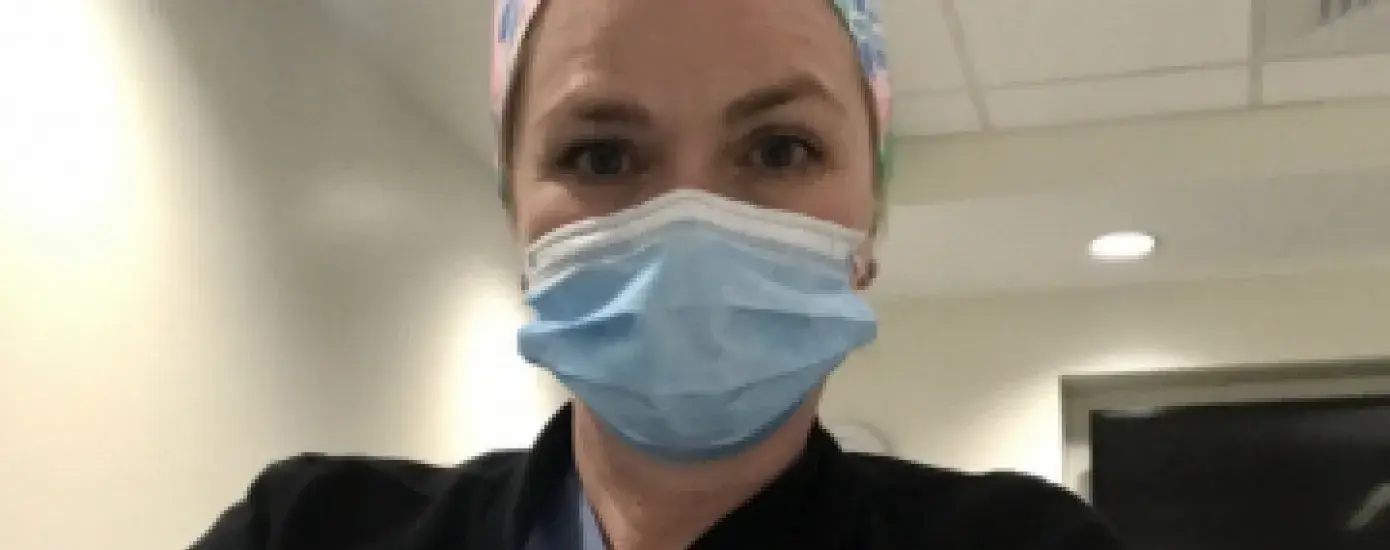


Think of how difficult it is for a new parent with their child in the neonatal intensive care unit. Now, add on that they can’t physically be with their child because they have COVID-19 or are considered a PUI – person under investigation. A totally heartbreaking situation.
That’s what Jennifer Duran has faced regularly since the pandemic began.
Duran is a nurse at Massachusetts General Hospital. She’s also a student in the MGH Institute’s Master of Health Professions Education (MS-HPEd) program so she can be an educator after she graduates.
The mother of four boys, she empathizes with new parents who are unable hold their newborn child right after delivery. “It’s emotionally hard but our job is to keep everyone safe,” Duran said, noting she was exhausted during the first several weeks of treating coronavirus patients because she found it difficult to sleep. “I feel like I want to cry sometimes, but as a nurse I just have to do my job. You really learn about yourself during a time like this.”
In one instance, Duran was among the Mass. General nurses who cared for the daughter of a Chelsea woman who was pregnant when she was admitted with severe COVID-19 symptoms. “Her husband was COVID-positive, and her other kids were, too, so it was a very difficult situation,” Duran said, adding the staff regularly delivered photos to the new mom, hoping the woman would awaken from being on a ventilator.
Eventually, the woman recovered enough to be transferred to Spaulding Rehabilitation Hospital in Cambridge where Christina Palmieri, a 2017 Master of Science in Nursing graduate of the Institute, was among the nurses who cared for her. Six weeks after first being diagnosed, the new mom was able to hold her daughter for the first time and was discharged to be reunited with her husband and other children – a happy outcome that buoyed Duran’s spirits. “It was nothing short of a miracle,” Duran said.
Her husband, Dr. Carlos Duran, works in the pediatric ICU at MGH and also is chief of pediatrics at Shriner’s Hospital in Boston. The couple has two small boys at home, so their new routine after working involves going in the back door, immediately removing their clothes, and showering before seeing the kids. “Our biggest concern is that our boys don’t get sick,” she said. The precautions are working, as everyone is healthy.
Duran joined the float pool of nurses who are deployed to other areas. After 24 years of caring for children, she’s adjusting to her new role – thanks in part to what she’s learning in the HPEd program.
“I’m able to look at things a little differently, such as how health workers are communicating with each other during this,” she said, adding that it’s been a challenge carving out time for the program’s online class while working 12-hour shifts, as well as picking up per diem shifts at another hospital. “I can really see this paying off after I graduate.”