

Alumni in Practice: Advocating Beyond the Clinic in Speech-Language Pathology
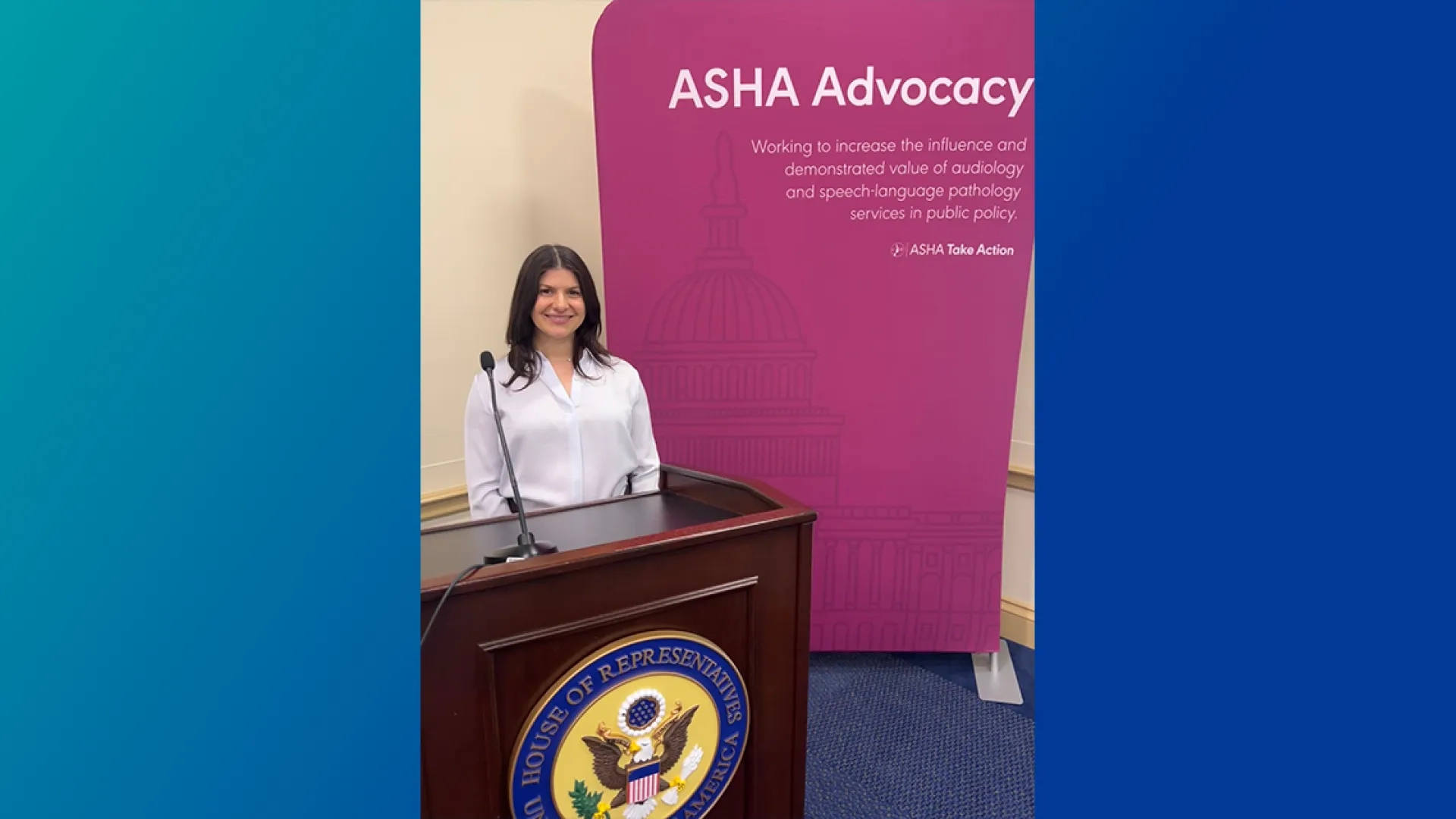


For Anna Dickstein, MS-SLP ’18, a career in speech-language pathology began with an interest in aphasia and neurorehabilitation, but her focus has quickly expanded. Since joining MedStar Health in 2018, she has combined clinical expertise with leadership in student training, professional education, and healthcare advocacy. Recently, she brought her expertise to Capitol Hill, speaking at a congressional briefing on communication disorders and the importance of protecting access to rehabilitation care.
What drew you to pursue a career in speech-language pathology?
I had a strong interest in aphasia and knew I wanted to work in an outpatient rehabilitation setting. I did ultimately end up working in outpatient neurorehabilitation within a large healthcare system in the Washington, D.C. metropolitan area, but what surprised me was realizing how much broader both the field and my interests were than I originally expected. Clinically, I’ve also developed strong interests in concussion, voice disorders, and high-tech augmentation and alternative communication (AAC).
Tell us a little bit about your current role.
I’ve worked for MedStar Health as an outpatient SLP since 2018. Clinically, I work with adults recovering from stroke, traumatic brain injury, concussion, voice disorders, and those with degenerative conditions. Alongside patient care, I am involved in leadership. A large part of my role involves directing our student training program, in which I partner with local universities to place SLP graduate students at our sites. I’m also involved in continuing education, in which I lead a lecture series and develop curriculum for SLPs within MedStar network.
How did the IHP prepare you for your current role?
The IHP fostered my curiosity and a mindset of lifelong learning. Health care is constantly evolving, and the program emphasized that continuing education and growth are important parts of being a clinician. Beyond clinical training, the IHP also gave me opportunities to explore interests outside of the clinic. I worked as a graduate assistant and completed a thesis under [Professor Emerita] Dr. Marjorie Nicholas’s mentorship, which helped me develop a well-rounded skill set.
Recently, you presented at a congressional briefing on “Caregiving for Adults with Communication Disorders.” What was this experience like?
This event involved a panel and multiple meetings with congressional staff advocating for a few of American Speech-Language-Hearing Association’s important priorities. The major focus of the event was helping congressional leaders better understand that communication disorders like aphasia affect far more than speech alone. They affect someone’s ability to participate in medical care, maintain relationships, return to work, advocate for themselves, and remain connected to their communities. We also discussed the very real impact these conditions have on caregivers and families. One thing I appreciated about the event was that it combined patient stories with clinical and systems-level perspectives. It allowed us to highlight not only the human impact of communication disorders but also the structural barriers that affect access to care. Some of the advocacy priorities we discussed included protecting Medicaid access, addressing Medicare reimbursement cuts that threaten rehabilitation services, and supporting access to student loans for future SLPs and audiologists to help sustain the workforce.
What are you currently working toward or excited about in your professional journey?
What I’m most excited about right now is continuing to grow beyond direct clinical care into more systems-level work within health care. I know that some of the most meaningful change in health care happens not only at the individual patient level but also through leadership, interdisciplinary collaboration, and building stronger systems that support both patients and providers.
What advice would you give to health professionals interested in this area?
Stay curious!