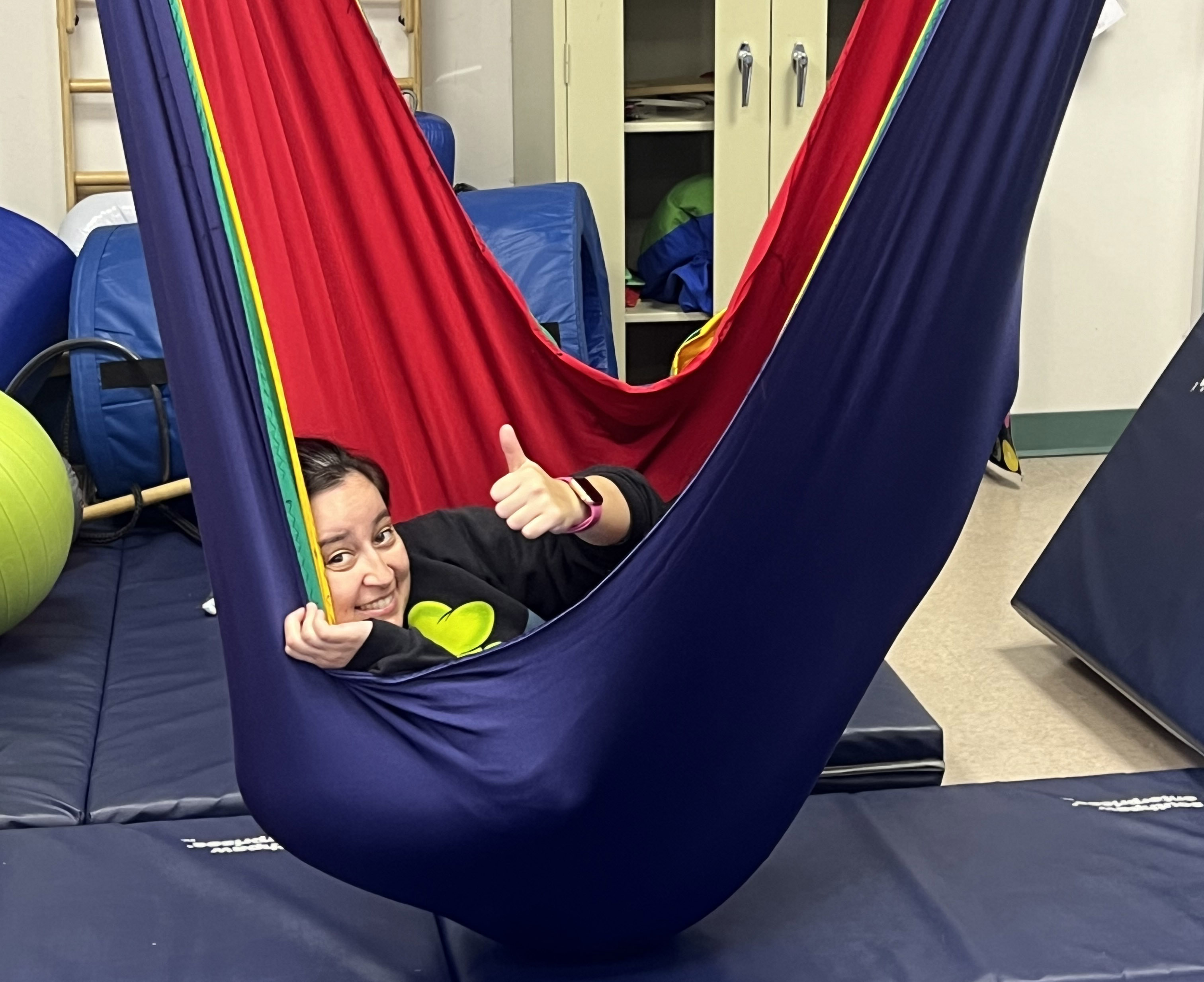


Marianne Linton, OTD ‘22
Tell us a little bit about your current role.
I am both the program director and an occupational therapist at the neurodevelopmental unit community-based acute treatment program (NDU CBAT) within the Italian Home for Children (IHC) in Jamaica Plain. We are the only CBAT in Massachusetts dedicated to serving kids ages 4–14 who have diagnoses of autism spectrum disorder or intellectual disability and are experiencing a mental health crisis. In my role as director, I oversee our clinical team and direct care staff to ensure the program runs smoothly. I am also client facing, providing consultative and group OT services.
What skills or knowledge gained during IHP’s OTD program have you found most valuable in this position?
I use principles of adaptation daily to find creative solutions to problems and ensure my staff members are successful in keeping our unit running smoothly. I found the IHP’s communications and teaching/learning classes extremely helpful in ensuring I am adjusting my communication to work with my staff effectively. It’s incredible how we also receive a leadership and management course through the IHP OTD program. I enjoyed that class and remember being validated and excited at the possibility to be a leader in my field after graduation. In terms of my role as an OT, I have been able to take the principles of group therapy I learned in our mental health course and adapt them to create a framework that NDU uses to meet our specialized population’s needs.
What motivates you to work in this setting and with this population?
After my fieldwork placements in outpatient pediatrics and inpatient psychiatry with adolescents, I left loving both populations. Finding a job in the NDU was a unicorn of opportunity — being able to work in pediatric mental health with a focus on serving the neurodivergent population. Working in mental health is a rollercoaster and can be extremely challenging (both with the clients and the staff!). However, I’m so drawn to navigating and solving the challenges because I have my team backing me every day, and the positive moments where kids have breakthroughs make the work incredibly rewarding. It’s fast-paced and every day looks different, but I wouldn’t have it any other way.
What does it mean to you to be both an occupational therapist and the NDU CBAT director?
It is an honor to be an occupational therapist leading a specialized mental health program. It fills me with pride. I recognize the privilege I hold being in a leadership position, now being able to be in the room with stakeholders and policymakers in mental health. I hold a responsibility to advocate for my clients and staff members to ensure all voices are heard, particularly in this complex time in which our nation’s leaders are speaking for, not with, the autistic population. We must work diligently and with dedication as occupational therapists to highlight what we can bring to the table as well as spotlight what our clients need. I’m grateful to wake up every day and be part of promoting a more radically inclusive world.
How would you describe your leadership style?
My style focuses on being collaborative and accessible with a sprinkle of comedic relief. I believe every member of the team should have a say in decision making, with me as the final decision maker who makes sure we keep operations moving. I’d compare it to being the captain of a sailboat. I think it’s incredibly important for leaders to be approachable and physically accessible to their team. Although I spend an unfortunately large amount of time behind a computer, I make sure to spend time on the unit chatting with staff, and people know they can always meet with me if my door is open. I think the best teamwork stems from a team that has trusting relationships with one another. Lastly, I believe it’s incredibly important that there are set times to be serious but also times to joke around and laugh. We must have fun in this line of work!
What is one way you encourage interprofessional collaboration among your team?
Fostering an environment that normalizes asking questions and learning from one another. I have realized that you can be an expert of your own craft, but unless you feel empowered to ask what others do and their scopes, successful collaboration cannot happen. You can become so much more powerful as a practitioner when you express curiosity to learn from other disciplines! I am so grateful to have learned so much from my fellow social workers, behavior analysts, and speech language pathologists at IHC.
What advice might you give to an IHP alum who is considering applying for a leadership role?
Do it! Go to that interview ready to advocate for the benefits that you are uniquely positioned to bring to the table! Highlight and demonstrate to the interviewers that we as OTs are qualified to be creative and collaborative leaders that lead with compassion and understanding. The world will be a better place with more occupational therapists in charge!