Unlocking the Future of Neuroscience: Open Neurophysiology with NWB and DANDI


The modern landscape of neuroscience is rapidly evolving—fueled by massive data collection, increasingly complex experiments, and a growing demand for reproducibility. In a recent lecture, Dr. Ben Dichter, founder of Catalyst Neuro, introduced a powerful ecosystem for addressing these challenges: Neurodata Without Borders (NWB) and the Distributed Archives for Neurophysiology Data Integration (DANDI) Archive.
Together, these tools are transforming how neurophysiology data is standardized, shared, and reused across the global research community.
Why Share Neuroscience Data?
Neuroscience data, especially in neurophysiology, is extraordinarily valuable and expensive. Recording brain activity in humans or animals demands high-cost equipment, countless hours of labor, and often the use of live subjects. Yet, much of this data is underutilized after a single study. Why? Because sharing it is hard.
Data exists in dozens of proprietary formats, often lacks key metadata, and can be enormous in size, ranging from 100 GB per session to several terabytes per dataset. Reusing data or tools across labs becomes an uphill battle, leading many scientists to simply collect new data instead.
Dr. Dichter’s mission is to change that.
The Vision: Open, Reusable, Machine-Readable Data
Imagine a future where neuroscientists, instead of designing a new experiment from scratch, could first query an open archive to explore existing data. Where grant proposals justify new experiments in the context of what’s already publicly available. This is not just a dream, it’s becoming reality, thanks in part to new NIH policies mandating data sharing with every funded publication.
To support this shift, Dr. Dichter’s team at Catalyst Neuro is building the infrastructure to make open science practical, scalable, and rewarding.
Meet the Tools: NWB and DANDI
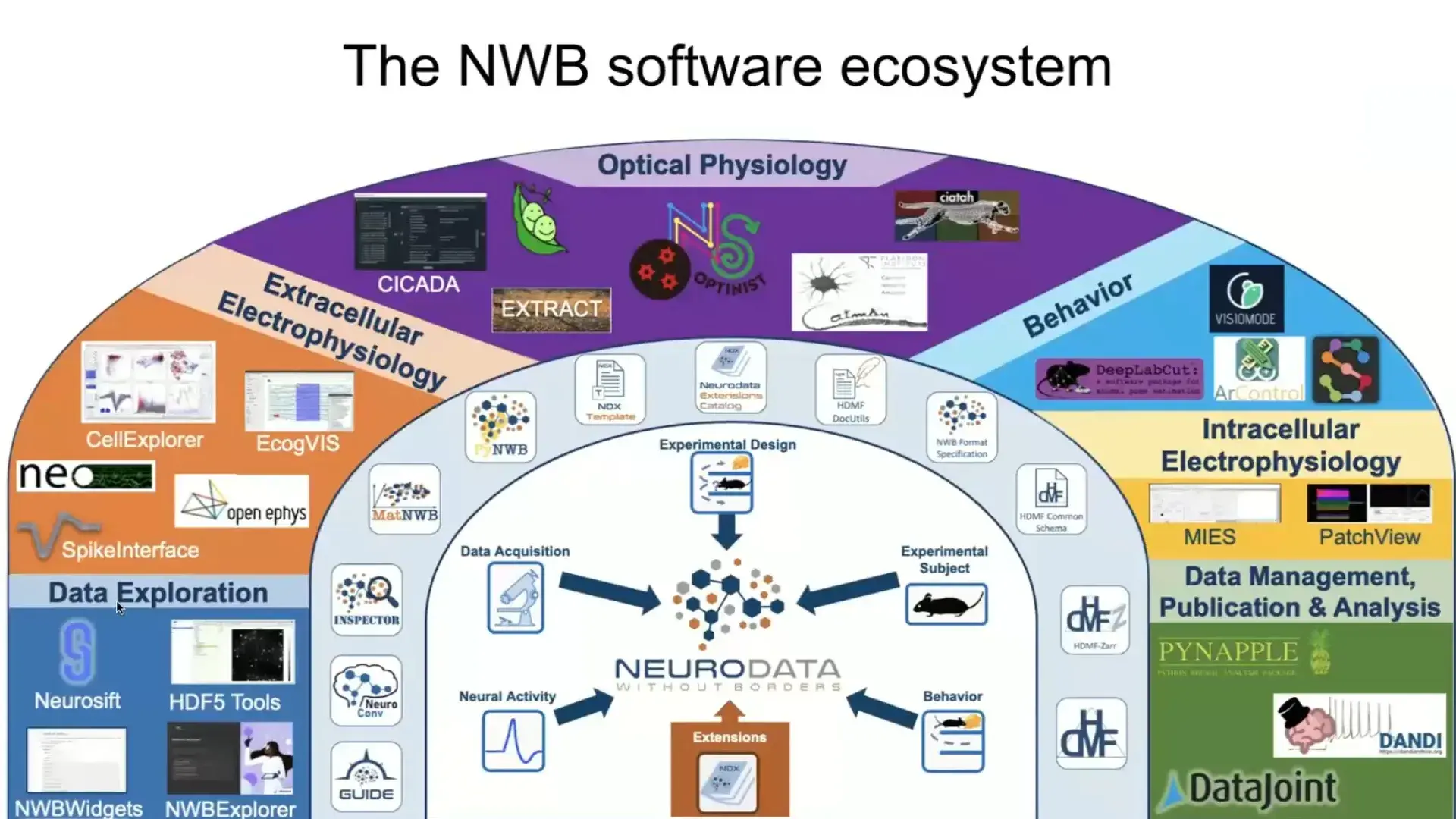
NWB is a data standard that organizes raw and processed neurophysiology data, like electrophysiology or calcium imaging into a unified, extensible format. Think of it like the "MP4 of neuroscience": one file, rich with metadata, accessible across platforms.
DANDI Archive, by contrast, acts like "YouTube for neurophysiology." It’s a free, cloud-based repository (hosted on Amazon Web Services) where researchers can upload, download, and explore NWB-formatted datasets with no file size limitations.
Together, they form a seamless pipeline for data conversion, sharing, visualization, and analysis.
From Data Collection to Reuse: A Researcher’s Toolkit
Researchers can easily convert proprietary formats to NWB using tools tailored to every skill level:
- NWB Guide: A user-friendly, no-code app (think TurboTax for data conversion)
- NeuroConv: A low-code Python library supporting 40+ data formats
- PyNWB / MatNWB: Full-feature APIs for custom, programmatic access
Once data is in NWB, it can be stored on DANDI, where it becomes fully searchable and reusable. Tools like NeuroSift let users visualize datasets directly in the browser—no downloads or installations needed. For deeper analysis, DANDI Hub offers free cloud computing with Jupyter notebooks.
What’s on DANDI?
DANDI already hosts 300+ datasets totaling over 300 terabytes, spanning:
- Mice, rats, humans, primates—and even ants
- Modalities like Neuropixels, calcium imaging, ECOG, and behavioral tracking
- Flagship projects like:
- International Brain Lab (33+ TB of decision-making data)
- Microns (co-registered functional + structural data)
- Agile12 (naturalistic human ECOG + motion tracking)
- First human Neuropixels recordings
Real Impact: Research, Education, and AI
The benefits of open neurophysiology data go beyond replication. Researchers can:
- Validate their findings on external data (confirmatory studies)
- Prototype analysis before data collection (pilot studies)
- Aggregate datasets across labs for greater power
- Develop and benchmark new tools
- Educate students using real-world experiments
Dr. Dichter also highlighted future directions like integrating genomic data, morphological mapping, and even AI-driven scientific querying of open archives.
Getting Involved
Interested in using or contributing to this ecosystem? You can:
- Explore DANDI Archive and download data freely
- Use the NWB Guide to convert your data
- Try interactive notebooks via DANDI Hub
- Join the community via Slack, GitHub, or workshops
- Apply for initiatives like Neurodata Rehack and Discovery Awards
Final Takeaway
Dr. Dichter’s message is clear: open, standardized neuroscience data is not only feasible—it’s essential. With the tools and platforms now available, researchers can accelerate discovery, improve reproducibility, and build a more connected scientific future.
The era of stockpiled neuroscience data is coming to an end. The future is open.