

Research Exchange Creates New Connections for University of Iceland Student
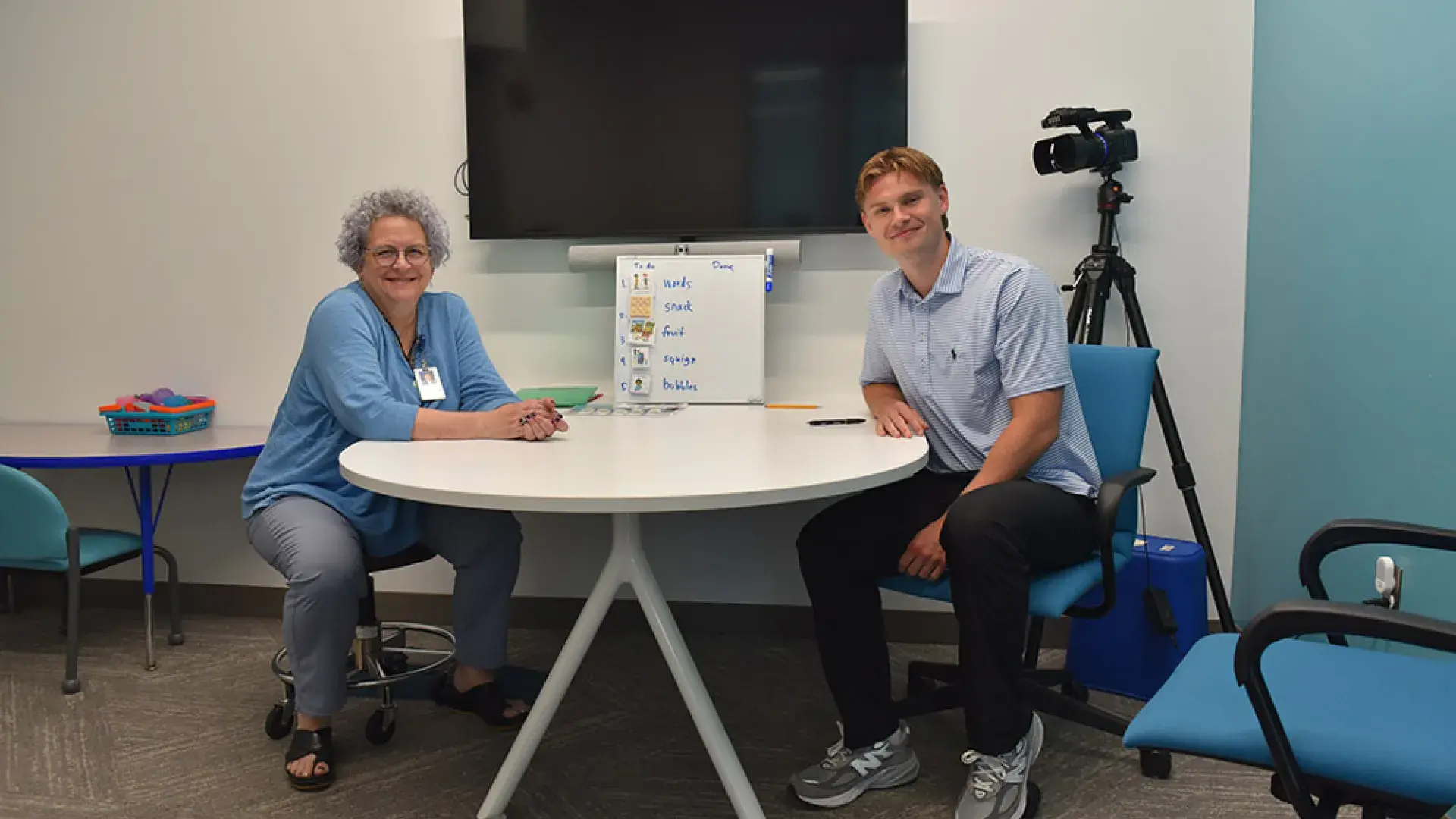


Hlynur Breki Harðarson is the first to take part in program
It has been a busy month for Hlynur Breki Harðarson. Before beginning his fourth of six years at the University of Iceland this week, he spent a month in Boston at the MGH Institute. Like most international exchanges, the learning opportunities extended beyond the lab.
Harðarson is the first person to take part in a research exchange between the MGH Institute and the oldest and largest university in Iceland. At the end of the third year, University of Iceland medical students finish the bachelor's part of the program by undertaking a research project. As part of that work, Harðarson connected with Karen Chenausky, Ph.D., CCC-SLP, on her work in the Speech in Autism and Neurodevelopmental Disorders (SPAN) lab concerning childhood apraxia of speech (CAS), which could be a factor that is limiting speech acquisition in many minimally verbal children with autism. Harðarson, who had previously worked with children with autism at summer camps, observed sessions with children with autism who are minimally verbal to see if there’s a difference in speech in children with CAS and without CAS.
“Studying kids with autism is a neglected research field, and they are finding that kids who are minimally verbal and have CAS is more common than we think,” said Harðarson.
“We were so happy to have Hlynur Breki visit our lab,” Dr. Chenausky said. “He was so enthusiastic about learning how to work with minimally verbal autistic children, observing the therapy sessions, and even offered to put us in touch with the summer camp he worked with. It’s wonderful to know that we have contacts in Iceland now.”
Harðarson also explored his interest in neurology while he was in Boston. He shadowed Andrew Tsitsilianos, MD, MS, who works in Physical Medicine and Rehabilitation at Spaulding Rehabilitation Hospital, joining him on rounds, touring the facility, and seeing what a typical day looks like.
“He was teaching me about new things in the rehabilitation center for spinal cord injuries, like Neuralink. In the future, we’re going to be able to put chips in heads below the lesion so that someone who had an injury can walk. He also showed me what I would call Terminator stuff, where there is an exoskeleton and electrodes that mimic the actual movements of the leg.”
The opportunity at Spaulding was arranged by the Institute’s Associate Provost for Research Nara Gavini, PhD, MPhil, who also shared helpful advice with Harðarson.
“He was really helpful at creating a future path of what I want to do as a medical student,” said Harðarson.
Gavini also suggested making connections outside of the MGH Institute. “He told me it wasn’t just about being here for the research. He said to make connections and talk to as many people as I could. As a result, I talked to some guy at a coffee house, and it turned out he is a resident doctor. I have talked to him on Instagram, and he gave me awesome advice.”
Those non-research related outings included trips to see the MIT and Harvard campuses as well as trips to the Boston Public Library, the Basketball Hall of Fame in Springfield, and a Red Sox game at Fenway Park. He explored the city by bike and took advantage of the running routes, although he didn’t account for one big difference between Boston and Iceland — the heat.
“I knew it was a big running city, but I made a big mistake. The first two days, I went running at noon and 2 p.m., but that was not possible. It was so hot and so moist. My resting heart rate was 10 beats higher here because of the heat.”
Another difference was how many institutions and hospitals there are in the Boston area compared to the centralized hospital system in Iceland, where he will spend the next three years in the clinical portion of his education. While he would like to return to the U.S. for another visit, next summer will be an opportunity for another student from the University of Iceland to follow his path and work on a research project as part of their bachelor’s thesis.
“The partnership between the MGH Institute of Health Professions and the University of Iceland brings together two institutions with distinct strengths, common challenges, and shared values,” said MGH Institute Provost and Vice President for Academic Affairs Reamer Bushardt, PharmD, PA-C, DFAAPA. “It is an opportunity to learn from one another, expand our academic and research horizons, and create meaningful connections across faculty and students. I am proud to see this collaboration come to life, and it has been an honor to host the first student exchange on our Boston campus with Hlynur Breki. This partnership has the potential to help both our communities grow and evolve together with a focus on academic excellence and innovation.”