

Nursing Lessons Learned at MGH Institute Now Being Taught in China
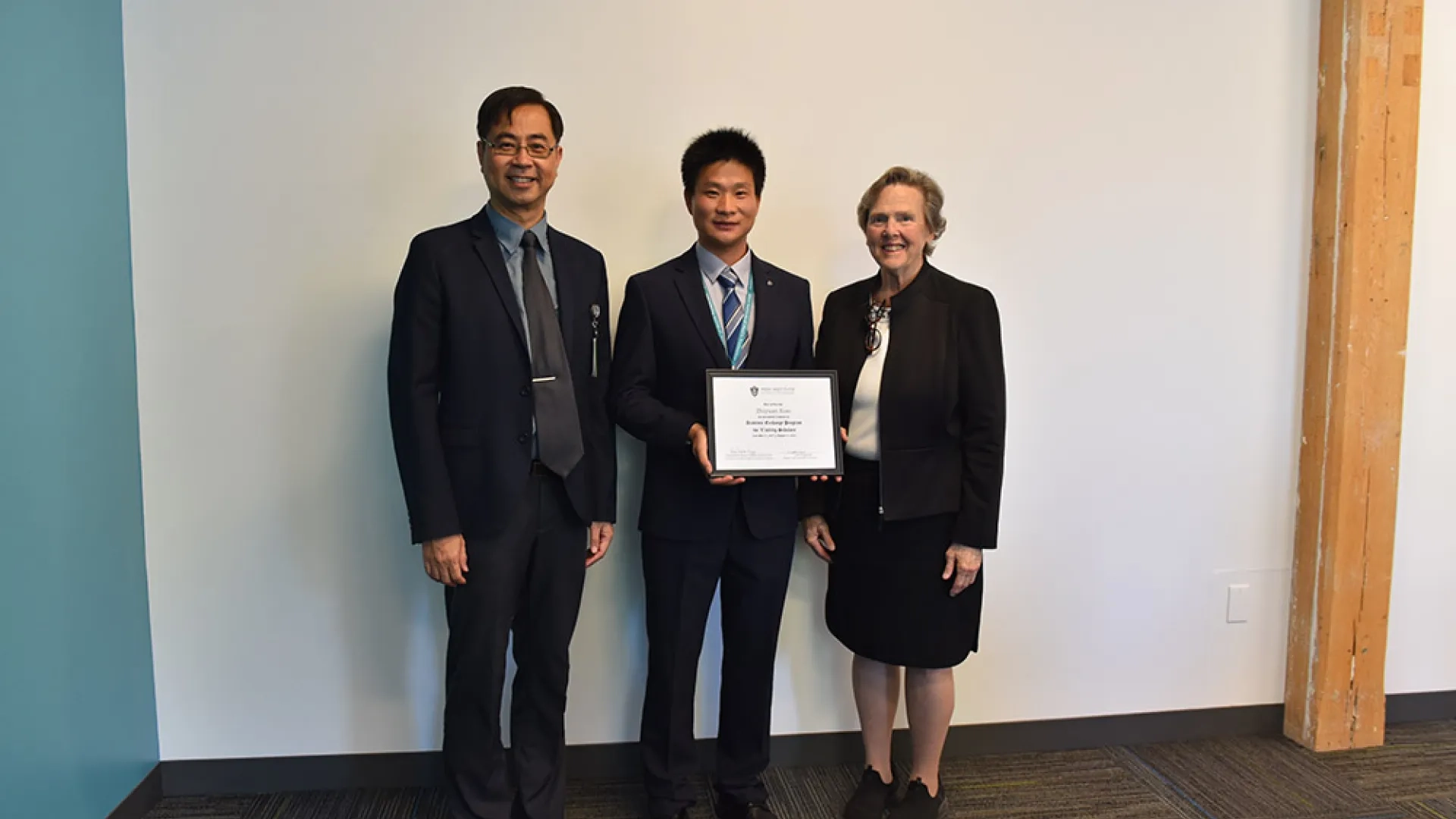


Visiting nurse practitioner Zhiyuan Xiao brings knowledge about nursing education and practice back to Beijing
Traveling to a new place is always going to result in new knowledge. That was certainly true for Zhiyuan Xiao, whose recent trip to the U.S. may lead to new learning opportunities for students in China.
Xiao traveled to the U.S. to learn how we educate nurses and how nurses provide care here during a fellowship with the MGH Institute School of Nursing. For three months, the nurse practitioner, who serves as the associate chief nurse and a clinical preceptor at Peking Union Medical College Hospital in Beijing, China, explored nursing theory, practice, and research across the MGH Institute and the Mass General Brigham system. Before he returned to China, Dr. Xiao shared his perspective of his immersive experience during a presentation in Shouse.
Education about Nursing Education
Being on the campus of the MGH Institute provided several opportunities for Xiao to learn about how students are taught here. While he was aware of the flipped classroom model, he was able to see the benefits of it firsthand. Observing class also showed him the value of the learner-centered philosophy of the Institute faculty.
“To teach is not only to transfer knowledge, but to also inspire and care,” said Xiao. “Every professor [at the MGH Institute] cared deeply about their students, not just in academic settings, but also in their daily lives. Their thoughtful course design and empathetic guidance truly touched me.”
He encountered other new concepts such as the nurse coaching umbrella model, a method he says is a powerful one to make highly competent and professional nurses. Outside of the classroom, Xiao took part in faculty development training that introduced him to drive theory, which gave him a framework to understand some of the issues that his students face when it comes to motivation.
“I plan to incorporate these elements into my future teaching to help students develop self-directed learning,” explained Xiao.
His interactions on campus included learning about interdisciplinary education through the Dr. Charles A. and Ann Saunders IMPACT Practice Center (IPC) and how the simulation lab can facilitate learning.
“At the IPC, patients receive valuable health support and students benefit from real world practice. It's a win-win model that I have never imagined,” shared Xiao. “Simulation allows students to think critically, communicate, developing their clinical skills in a process that help transform fragmented knowledge into clinical competence. It is a perfect example of learning through teamwork and reflection.”
Clinical Experiences
Xiao is a rehabilitation specialist who has extensive clinical experience in neurosurgery, general surgery, and cardiac surgery among others. His research currently focuses on perioperative nursing for neurosurgical patients, innovations in nursing education models, clinical leadership development, and palliative care. While he was in the U.S., he was able to see the different parts of the rehabilitation journey here. He visited the new surgery ward and the translation clinical research center at Mass General Hospital, learned about the short-term rehab available at Spaulding Boston, mid-term rehab at Spaulding Cambridge, and longer-term care at home and in nursing and care centers.
“I saw an innovative ceiling transfer system at Spaulding Boston, and how the rehabilitation gym at Spaulding Cambridge made therapy convenient and patient-centered,” explained Xiao. “In a long-term care facility, I talked to elderly residents, many of whom feel lonely and in need of care. Just talking to them brought joy and connection.”
Xiao also explored the community, joining several students on home visits to four Spanish-speaking families, which gave him insight into the world of community nurses and the importance of home-based care in the U.S. healthcare system. He engaged with high school students to answer questions about career paths and saw research demonstrations by students at Chelsea High School.
Transformative Experience
Xiao referred to his time at the Institute as a “once in a lifetime journey.” He was very thankful to President Dr. Paula Milone-Nuzzo and others for welcoming and teaching him and told his manager that he transformed during his time the Institute.
“I truly feel I have changed in perspective and confidence,” shared Xiao. “I plan to adjust my teaching management and research strategy based on what I've learned at MGH Institute.”
John Wong, an associate professor in the School of Nursing and the School of Health and Rehabilitation Sciences’ Department of Occupational Therapy, oversaw the Xiao’s fellowship. At his suggestion. Xiao wrote a weekly summary of what he had learned that week, which he plans to use to produce two academic manuscripts about his experiences.
“Just reading through them each week, I could tell that not only he has learned a lot, but he's actually going to use this when he goes back to China,” said Dr. Wong. Hopefully, when I bring our students or even faculty and staff over there, we can also learn from them as well.”
Do you have a story the Office of Strategic Communications should know about? If so, let us know.