

Nursing Alumna and Psychiatric Nurse Practitioner Helping Mold Careers at Salem Hospital
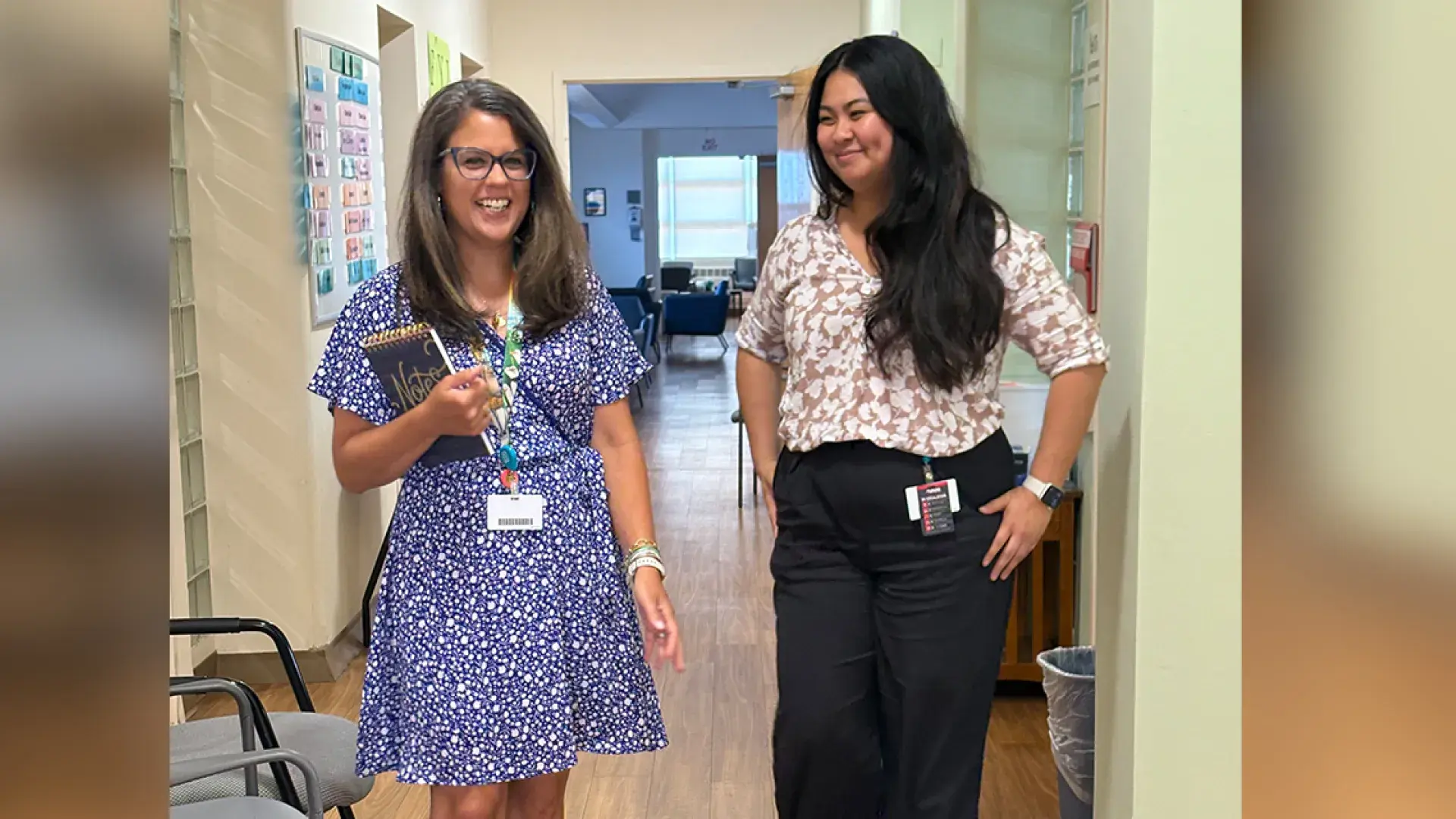


Stephanie Ferraro, 2012 MGH Institute graduate, energized by students and opportunities presented during clinical rotation
For Stephanie Ferraro, teaching and nursing are in her blood, and that’s why she loves what she does.
The 10-year veteran is a psychiatric nurse practitioner at Salem Hospital, where she is in charge of diagnostic evaluations, safety assessment and monitoring, and medication management for the Adult Partial Hospital Program within the Department of Psychiatry. She’s also director of the MGH Institute’s nurse practitioner student training program at Salem Hospital.
“I have four students at a time; they rotate from me and a few other preceptors in our department,” said Ferraro, who has been with Salem Hospital since 2014. “So, the students have really good, well-rounded experiences where they get to see different sites in psychiatry.”
Training students while also handing one’s full-time job can be challenging, but Ferraro relishes the opportunity, especially when she see what her clinical rotations provide students who may someday be colleagues.
“They get to see patients in various settings, various ages, and various circumstances,” observed Ferraro. “And it's been really nice to have that type of cohesive training program where students get experience in all these different sites. A lot of times students get put in clinical sites, and it's very particular to that setting - just pediatrics, or just outpatient, or just inpatient. It's great to offer as much exposure as we do because it's easy to go into school and think, ‘I want to do this,’ but then you get exposure to different types of environments, and you see there are other opportunities.”
Ferraro points to her own department as Exhibit A. She helps manage Salem Hospital’s Adult Partial program, which is a day hospitalization psychiatric program involving an interdisciplinary team of nurse practitioners, social workers, and mental health counselors.
“I never heard of a program like this until I arrived, and many of my students haven’t either. It's primarily a group-based treatment, and I work alongside the case managers and manage the patients,” noted Ferraro. “Our patients are there for a two-week program, which is a really great program. They get individual therapy and group-based treatment. They get the diagnostics and medication management from me. The group-based treatment is a little bit of a higher-level focus than patients typically receive in inpatient settings, because patients in our program aren't as acute.”
And there every step of the way are MGH Institute nursing students, who Ferraro says, set themselves apart from students who come from other schools.
“They’re motivated, they're really professional, and they're really driven,” said Ferraro. “The MGH Institutes selects a really excellent group of students. I've had really positive experiences with all the students. They're prepared. They're eager to learn. I like the collaboration and the connection in keeping things within MGB too, which makes sense. We're all in the same place – why not keep the connection and collaboration going? And it's mutually beneficial - we've hired a couple of people that I've trained over the years, so it's a great recruitment opportunity for our department.”
It’s the student exposure to new concepts and experiences that keeps Ferraro, a 2012 MGH Institute graduate of the Direct Entry Nursing program herself, energized in running Salem Hospital’s Nurse Practitioner training program, which sees students rotating through the hospital’s consult-liaison service.
“That service is responsible for emergency room evaluations and psychiatric evaluations on the medical units,” said Ferraro. “So, if you have somebody that's medically admitted for cardiac issues but they're having psychiatric issues at the same time, someone from that team will go and provide psychiatric care to the patients while they're receiving medical care. So, that's really cool exposure, too - it's a good intersection of medicine and psychiatry, and how the two are so connected. And it's a very immersive experience. Students have given really wonderful feedback of it being a really great clinical placement because they really learn a lot and boost their medical knowledge.”
It’s not just the boosting of medical knowledge in play with the clinical rotations the MGH Institute graduate oversees, but rather the multiple touchpoints for future nurses.
“I've had students rotate through the geriatric inpatient unit, the adult inpatient unit, the pediatric inpatient unit, the out patient department. I have guest speakers come and talk to the students,” rattled off Ferraro. “I usually have students that I've had in the past come back in the spring, and they'll talk to the students about what it's like to look for your first job, the interview process, negotiating, and what it feels like to be a new NP right out of school, because that's pretty stressful. So that's been really great.”
For this alumna, keeping the pipeline strong between the MGH Institute and Salem Hospital is a significant driver.
“I feel honored to be asked to do something like this, to hear nice feedback. I've gotten really nice feedback over the years from the directors of the program and from my students. Some of my students say, ‘This is one of the best clinicals.’ It's really nice and makes me feel good that we’re providing such a good environment, and that they feel that they're learning. And that's not just me. We have a really great department that's also really welcoming to nurse practitioners and trainees.”
For Ferraro, her career and attachment to Mass General Brigham is personal; Massachusetts General Hospital is where she began her career, where she met her husband, and where both of her parents worked until their retirements.
“I've always been connected to MGH my entire life – it was such a comfortable place for me,” observed Ferraro. “My first job out of college was at MGH. My second job was MGH. Then I went to the MGH Institute for school. So, it feels like very full circle to be able to stay in the system.”
A healthcare system where she’s able to care for patients and mold careers along the way.
“I like what I do - I like teaching,” concluded Ferraro. “It feels like it connects everything together. It makes it meaningful and purposeful to be able to give back to the students who then give back to the community in these kinds of ways.”
Do you have a story the Office of Strategic Communications should know about? If so, let us know.