

New Doctor of Audiology Class Graduates Six
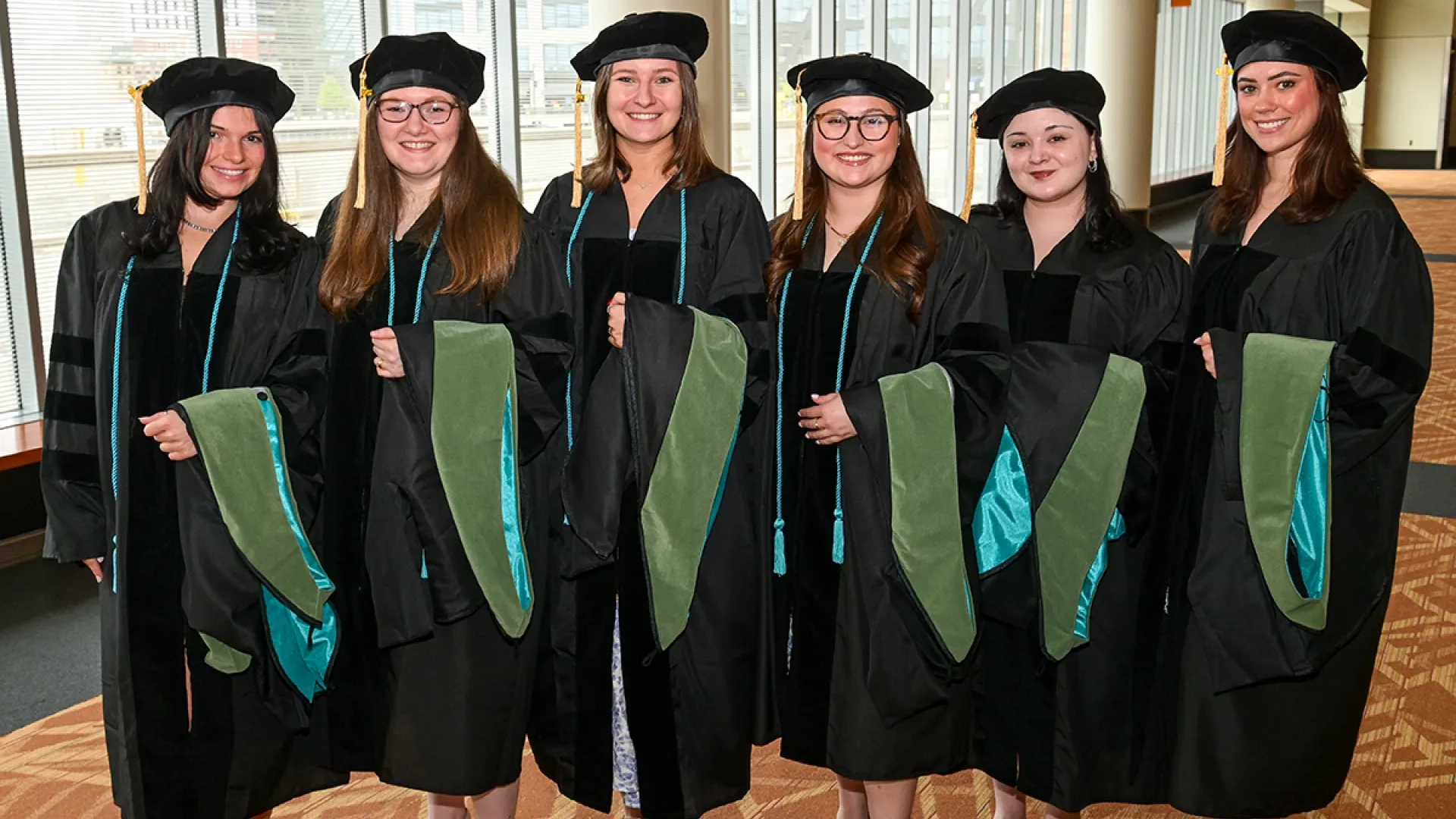


Responding to national shortage, audiology program leverages Mass Eye and Ear connection to provide top-flight experience
Sydney Zech and Marissa Gallan were beaming during Friday night’s award ceremony and Saturday’s Commencement.
“I feel great,” said Gallan. “I'm very excited.”
Excited to be receiving a Doctor of Audiology degree and thrilled to have been part of the MGH Institute’s first class of audiologists.
“It's an honor to be in the first cohort,” reflected Sydney Zech. “I feel like we like figured things out as we went and we made it happen.”
The duo were part of six graduates who walked across the stage on Saturday at the Thomas M. Menino Convention & Exhibition Center and stepped into history.
“Obviously, they're the first in every way; the first voices in every classroom, every experience, everything about every aspect of the program. They were the first to do it,” marveled program director Andrea Pittman. “That takes bravery, commitment, and grit to get through all of that. And they did it, and they did it great.”
The program was created in response to a national need. Currently, there are 15,000 audiologists in the United States, but ~30,000 are needed. With only 800 new graduates entering workforce each year, the pipeline infrastructure isn’t built to narrow the workforce gap anytime soon.
“Even if every single program in the country doubled their enrollment, it wouldn't even be a drop in the bucket to how many audiologists are needed,” noted Pittman. “That gap is just getting wider, and it's going to be getting wider through the 2030’s.”
The MGH Institute’s Doctor of Audiology program, one of only two in the Commonwealth, will help chip away at the gap with graduates like Hannah Hardy, who is taking a job in private practice on the North Shore.
“I'm excited,” beamed Hardy. “I’m very excited to get back into the workforce and be able to really start helping people.”
Other graduates of this first cohort include Morgan Cassford, Callaway Sheedy, and Abigail Wenner.
The new program was challenging, as students took approximately 800 hours of classroom instruction with 15 different faculty, and almost 2000 hours of clinical training with a countless number of preceptors, all in a three-year period.
“This is not a small thing that these graduates have done,” noted Pittman. “Being the first, they laid the foundation for all future students; they allowed us to learn from them about what worked and what didn't work in the Boston context, so that we can make it better for every cohort after them.”
A highlight of the program is the close collaboration with Mass Eye and Ear, where students take classes and go through clinical rotations.
“The Mass Eye and Ear partnership specifically was really cool to be part of because people come from all over the world to Mass Eye and Ear,” remarked Hardy, who is finishing her final year externship at Mass Eye and Ear. “And I have just gotten so much experience in more niche areas of audiology that I wouldn't have gotten in a different scenario. So, that gave us a really strong clinical base.”
“Mass Eye and Ear has been the best collaborator I've ever worked with,” said Pittman. “We didn't realize how extraordinary the training was until we started seeing the student successes as they're getting into their externships and now their jobs. Take the national practice exam for example – it’s difficult and the passing rates have been going down steadily, but our students took it and passed it, and even our students in our next class are taking it and passing it earlier than they’re supposed to be.”
With a 100% job placement rate, the Doctor in Audiology program is off to a strong start.
“I'm going to work at Mass Eye and Ear,” said an excited Zech. “So, it’s kind of full circle.”