

MGH Institute Leaders Help Shape National Dialogue on Future of Health Professions Education
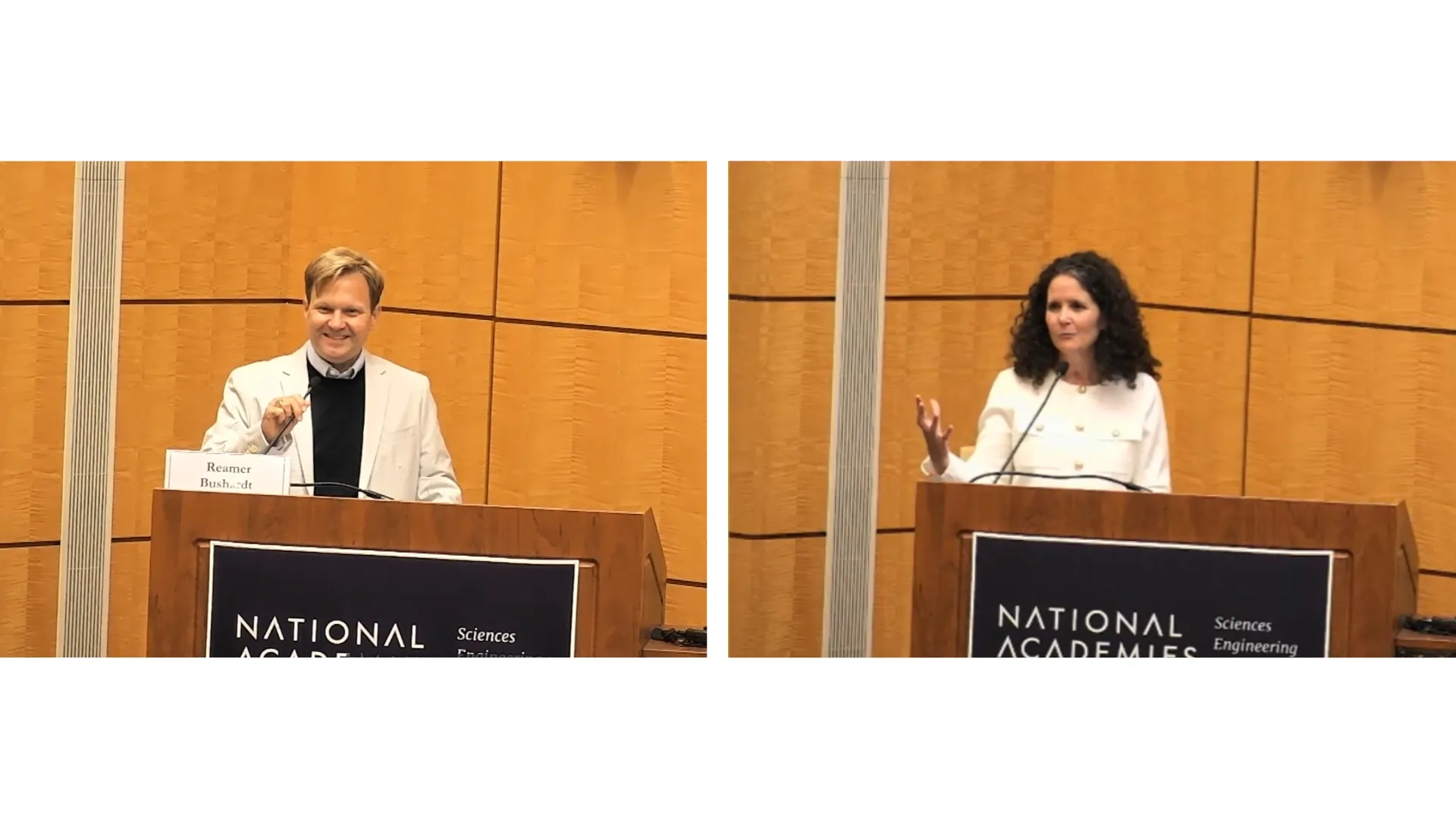


Leaders from the MGH Institute of Health Professions played a central role in a national convening at the National Academies of Sciences, Engineering, and Medicine, helping to shape a forward-looking conversation on how to redesign health professions education for a rapidly changing higher education and healthcare landscape.
Provost and Vice President for Academic Affairs Reamer Bushardt, PharmD, PA-C, DFAAPA, and Associate Provost and Dean of Interprofessional Education and Practice Regina Doherty, OTD, OT, OTR, FAOTA, FNAP, served on the planning committee and in key leadership roles for the two-day workshop, Envisioning a More Nimble System for Educating Health Professionals. Bushardt was co-chair of the workshop series alongside Ryan Scilla, MD, MS-HPE, Director of Medical and Dental Education for the U.S. Department of Veterans Affairs Veterans Health Administration, bringing a national health system perspective to the design and facilitation of the sessions.
Held at the National Academies’ Keck Center in Washington, D.C. on April 27-28, the event brought together approximately 500 participants from across academia, health systems, policy, and professional organizations.
The workshop is part of a year-long Global Forum series examining how health professions education can evolve to better align with workforce needs, technological advances, and the realities of modern care delivery. The Global Forum serves as a national and international platform for cross-sector collaboration, convening leaders to address some of the most pressing challenges in preparing the healthcare workforce.
As co-chairs, Bushardt and Scilla helped guide both the design and execution of the workshop, framing discussions around the early stages of transformational change by creating urgency, building coalitions, and developing a strategic vision. The sessions brought together diverse perspectives to explore how education systems can become more responsive and adaptive in real time.
“The current model of higher education was built for a different era,” said Bushardt. “Our institutions, along with the accreditation and regulatory systems that support them, were intentionally designed to be stable, rigorous, and enduring. Those are real strengths. But in a time when healthcare, technology, and workforce needs are evolving so rapidly, those same structures can make it difficult to adapt at the pace the moment demands.”
Throughout the two days, nationally recognized leaders contributed perspectives from across disciplines and sectors. Speakers included bioethicist and health policy expert Dr. Ezekiel Emanuel of the University of Pennsylvania; workforce and education leaders from National Health Services in the United Kingdom and the University of Pittsburgh; and academic leaders from institutions such as Vanderbilt University Medical Center, Rosalind Franklin University, and the American College of Lifestyle Medicine.
Sessions explored how emerging forces, particularly artificial intelligence, evolving workforce demands, and shifting care models, are challenging traditional approaches to education. Discussions also emphasized the importance of strengthening partnerships between academic institutions and health systems, developing competencies that can adapt over time, and preparing learners not just for current practice, but for continuous change.
Doherty played a prominent role as moderator of a featured session focused on the intersection of health policy, population health, and education. In conversation with Emanuel and other national leaders, they explored how the U.S. healthcare system is under significant strain, marked by rising costs, uneven access, workforce shortages, and increasing complexity. These challenges place new demands on how health professionals are educated and prepared, reinforcing the need for closer alignment between education, practice, and policy.
“One of the most powerful aspects of the conversation was the recognition that education must be more nimble,” said Doherty. “Policy, practice, and education are deeply interconnected. If we want a more adaptive system, we must design with that full ecosystem in mind and ensure that interprofessional collaboration is at the center of it.”
Across sessions, a consistent theme was the need to move beyond static, time-based training models toward approaches that emphasize adaptability, lifelong learning, and real-world alignment. The concept of the master adaptive learner, a professional equipped to continuously learn and adjust in complex environments, emerged as a unifying vision for the future.
The urgency of this work is amplified by broader pressures facing higher education and healthcare alike, including rising costs, rapid technological change, increasing regulatory complexity, and the approaching demographic cliff that is expected to reduce the number of traditional college-aged learners in the coming years.
For the MGH Institute, participation in the Global Forum reflects both its mission and its growing leadership role at the intersection of education, workforce development, and health system innovation. As an academic institution embedded within Mass General Brigham, the Institute is uniquely positioned to help bridge the gap between how health professionals are educated and how care is delivered.
This approach is already reflected in the Institute’s work, including the development of new workforce-aligned programs such as cardiac ultrasound and behavioral health training pathways, interprofessional partnerships across the Mass General Brigham system, and a growing portfolio of initiatives designed to better connect education, clinical practice, and community needs.
“We are not simply preparing students for today’s workforce,” noted Bushardt. “We are helping to shape what that workforce needs to become. Participating in national and global conversations enables us to contribute to and help lead the redesign of health professions education in ways that better serve patients, communities, and the health systems with which we partner.”
The April workshop represents the second in a series of convenings that will continue over the coming year, with insights informing ongoing national dialogue on how to build a more adaptable and sustainable future for health professions education.