

Massachusetts General Hospital and MGH Institute Team Up to Determine What Happens to Brain During Intense Stroke Rehabilitation
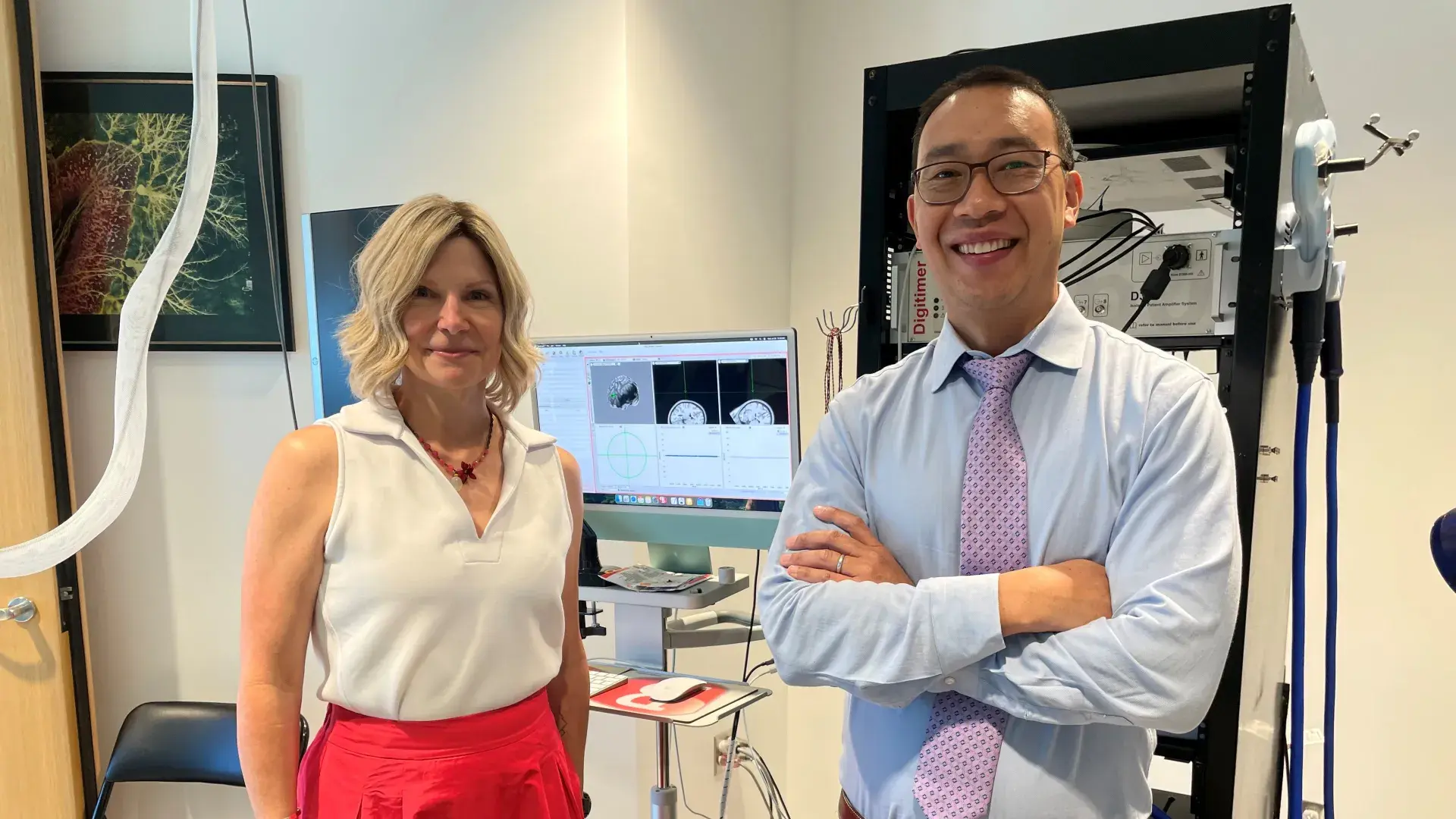


Institute’s Teresa Kimberley and MGH’s David Lin launching first-ever study; results could impact future stroke rehabilitation
It’s widely understood that when stroke survivors undergo rigorous rehabilitation, their movement tends to improve. But what happens to the brain - does it change? And if so, how?
These are fundamental questions that have never been examined before, until now.
The MGH Institute’s Dr. Teresa Kimberley is teaming up with Massachusetts General Hospital’s Dr. David Lin to answer these very questions. They have received funding from the National Institutes of Health for their project, “Defining the Neurological Substrates of Proximal Upper Extremity Motor Control and Recovery after stroke.” It’s a $2-million grant over five years.
“This fundamental question really hasn't been studied in humans in a rigorous way before.” said Dr. Lin, PI of the grant, Director of the Neurorecovery Clinic at Massachusetts General Hospital (MGH), Faculty in the MGH Center for Neurotechnology and Neurorecovery, and an Assistant Professor at Harvard Medical School. “Our grant is simply asking the question: what changes in the brain in response to high dose, high intensity, rehabilitation?”
Drs. Lin and Kimberley have a long history of productive collaboration having published multiple papers before in stroke. For this project, they will specifically focus on hemiparesis (weakness on one side of the body) and the rehabilitation of the arm.
“If you understand how the brain repairs itself in response to rehabilitation, you can potentially speed up recovery,” said Kimberley, Director of the MGH Institute’s Brain Recovery Lab, “Improved brain connections will have downstream effects of improving function.”
If the brain does indeed change, and the study team can determine how it changes, could the findings affect how stroke survivors are treated?
“Absolutely,” confirmed Lin, who is also an Adjunct Assistant Professor of Rehabilitation Sciences at the MGH Institute. “It would for the first time establish a neuroscientific basis to what physical, occupational, and speech therapists do on a daily basis and would influence practice.”
Kimberley says this is the most in-depth look at what happens to the brain during stroke rehabilitation. The study team will utilize Transcranial Magnetic Stimulation (TMS) and Magnetic Resonance Imaging to understand what's happening in the brain.
“How does the brain activate the muscle and connectivity? How well are various parts of the brain talking to each other?” asked Kimberley, who is a research associate at Harvard Medical School, Spaulding Rehabilitation Hospital, Massachusetts General Hospital, and the Center for Neurotechnology and Neurorecovery. “We want to ultimately understand the stroke pathophysiology better, so that future trials and treatments can understand how the brain itself is healing.”
The study will look at two groups of stroke survivors – those receiving standard care that comes after a stroke, and those receiving intense therapy – to see what the differences are in brain activity resulting from the different therapy approaches.
“In the group getting elevated care, does their function improve? We will assume so,” said Kimberley. “But then the question becomes, are we actually changing the brain? We're going to be able to assess the normalcy of their movement and how that corresponds to brain activation and pathway changes. We'll be able to quantify explicitly that joint control improved in this way, and that relates to this part of the brain. So, it's really detailed analysis.”
Looking at the bigger picture, if the study shows marked improvement in brain activity because of intense post-stroke therapy, a case can be made to change the treatment stroke patients typically receive.
“We know that after the typical stroke rehabilitation, improvements are limited, because the prescribed rehabilitation is limited,” said Kimberley. “This study will be a way to look at how much your function improved and what happened to the brain function when you received extensive rehabilitation compared to standard care. So, this would be a way to say something about the type of care that we are giving stroke survivors.”
The study will be conducted at the Center for Neurotechnology and Neurorecovery at Massachusetts General Hospital and at MGH Institute’s Brain Recovery Lab.
“Teresa and I are really excited and inspired to start this study,” said Lin. “It's a study that investigates a fundamental question in our field. And it's a testament to the environment at Mass General and the MGH Institute of Health Professions that supports our collaborative investigation.”
Do you have a story the Office of Strategic Communications should know about? If so, let us know.