

Mass General Hospital Research Coordinator Pursuing Nursing Degree to Combine Two Passions
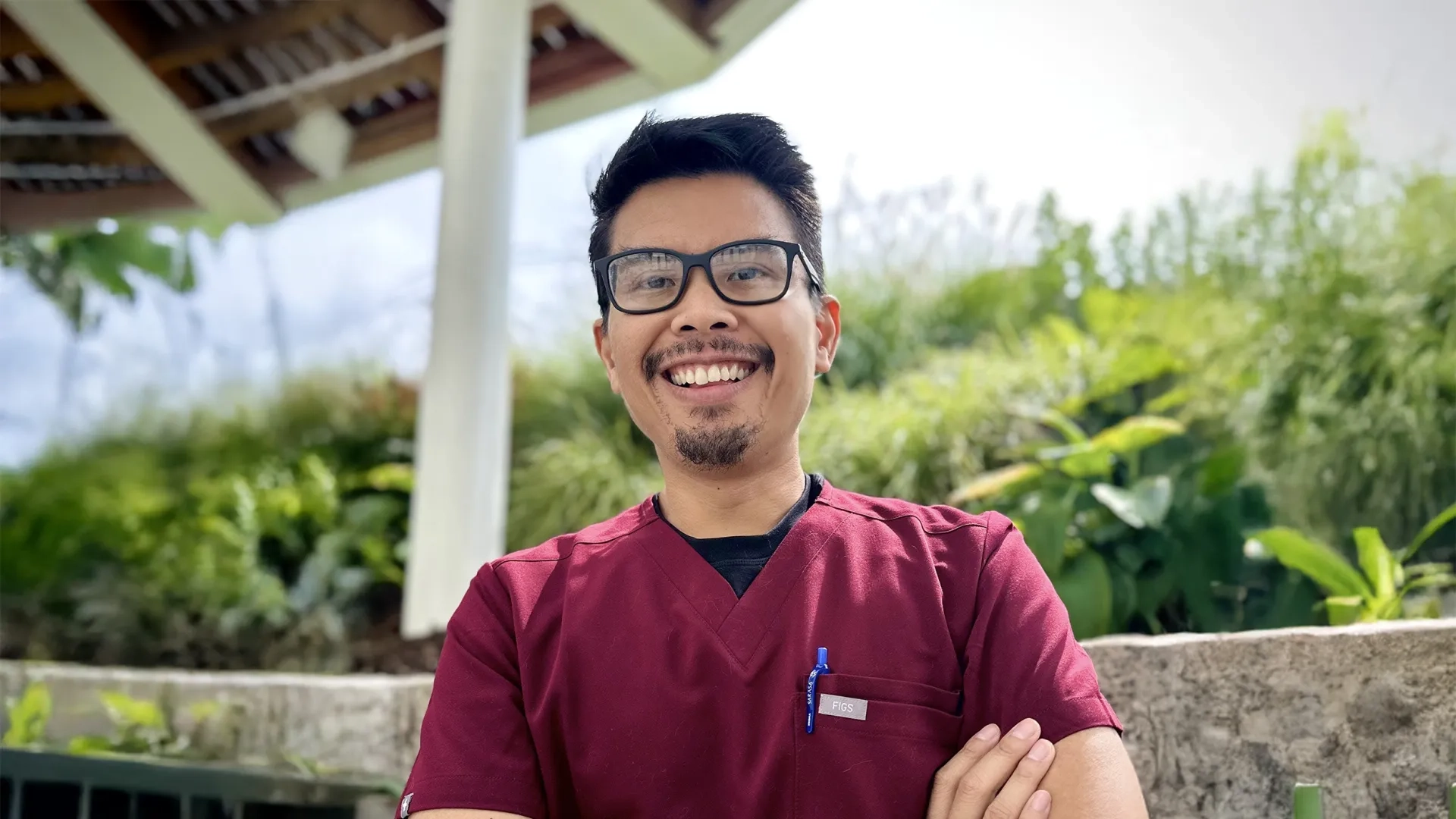


Patient interaction and research are what’s driving this nursing student
For Mark Chicote, the career goal is simple: combine research with being a nurse practitioner. And he’s well on his way.
While pursuing his nursing studies at the MGH Institute, he also works per diem as a clinical research coordinator in the Neuroendocrine Unit at Massachusetts General Hospital (MGH), where he has worked alongside Dr. Laura Dichtel for the past five years. Under Dr. Dichtel’s supervision, he was the lead coordinator on several clinical studies on the impact of growth hormone on steatotic liver disease. Despite his success in research, what excites him most is the opportunity to interact with patients.
Chicote’s path toward patient care began not long after he finished his undergraduate work at UMass Amherst and went to Harvard Extension School to pursue a post-baccalaureate certificate. An email indicating the Neuroendocrine Unit at Massachusetts General Hospital was looking for student interns interested in pursuing clinical research sparked his interest.
“In the back of my head, I had always wanted a career that would allow me to bridge my research experience with real-world patient care. I came from a heavy undergrad research background: from studying how brain circuits influence behavior in Neurobiology to completing an honors thesis in the Kinesiology Department, where I assessed the validity of consumer-grade heart rate monitors in elite runners,” recalled Chicote. “When I entered my post-baccalaureate career at Harvard, it felt like, ‘This is the perfect opportunity for me, because I wanted to do patient care and research.’ So, I started as an intern back in September 2019.”
And that led to a choice — medical school or nursing school.
“I realized nursing would allow me to pursue both research and patient care in a more direct, timely way,” recounted Chicote.
After the decision not to pursue medical school, Chicote began shadowing nurse practitioners, physical therapists, hospital pharmacists, to explore different roles to find his niche.
“Being a nurse practitioner appealed to me for a number of reasons: the balance between close patient interaction and advanced clinical training. What drew me to the NP role was how it integrates nursing’s holistic, patient-care centered philosophy with advanced clinical expertise. That ability to connect closely with patients while also applying evidence-based care is exactly the kind of practice I want to build.
So Chicote applied to the MGH Institute’s Direct-Entry Master of Science in Nursing to become a nurse practitioner. Over the summer, he landed an opportunity at the Beth Israel Deaconess Medical Center’s Outpatient Clinic Dermatology as a medical scribe, a role he still holds alongside his per diem clinical research coordinator role.
“Balancing these experiences complements my path toward becoming a nurse practitioner by teaching me how providers integrate research into practice, engage in patient education, and manage complex care across both outpatient and academic settings,” noted Chicote.
Set to complete the BSN portion of his program in January 2026 and begin NP training in that September, his long-term goal is to unite research with advanced practice — a combination he rarely sees in the field.
“A lot of the nurses and nurse practitioners that I work with are focused on bedside care, which is essential to the profession,” observed Chicote. “I'm hoping to build a career that also integrates research, combining both aspects in a way that’s less common.
“I’m enjoying my time in the program, but it's also very fast paced,” noted Chicote. “All of this preparation comes into play when we start seeing patients at our clinical rotations. It amazes me how much information is retained in the back of my head.”
Until then, Chicote has much to balance.
“I like to call myself a working student; balancing work and graduate school is eye-opening and rewarding, as it has taught me new ways to manage work-life balance and responsibilities. As an endurance runner, I’ve learned to approach life like a marathon, not a sprint — pacing myself, pushing through challenges, and keeping my long-term goals in focus. The MGH Institute is preparing me for that opportunity to grow and become stronger in how I tackle real-world challenges.”
Do you have a story the Office of Strategic Communications should know about? If so, let us know.