

Leveling the Playing Field
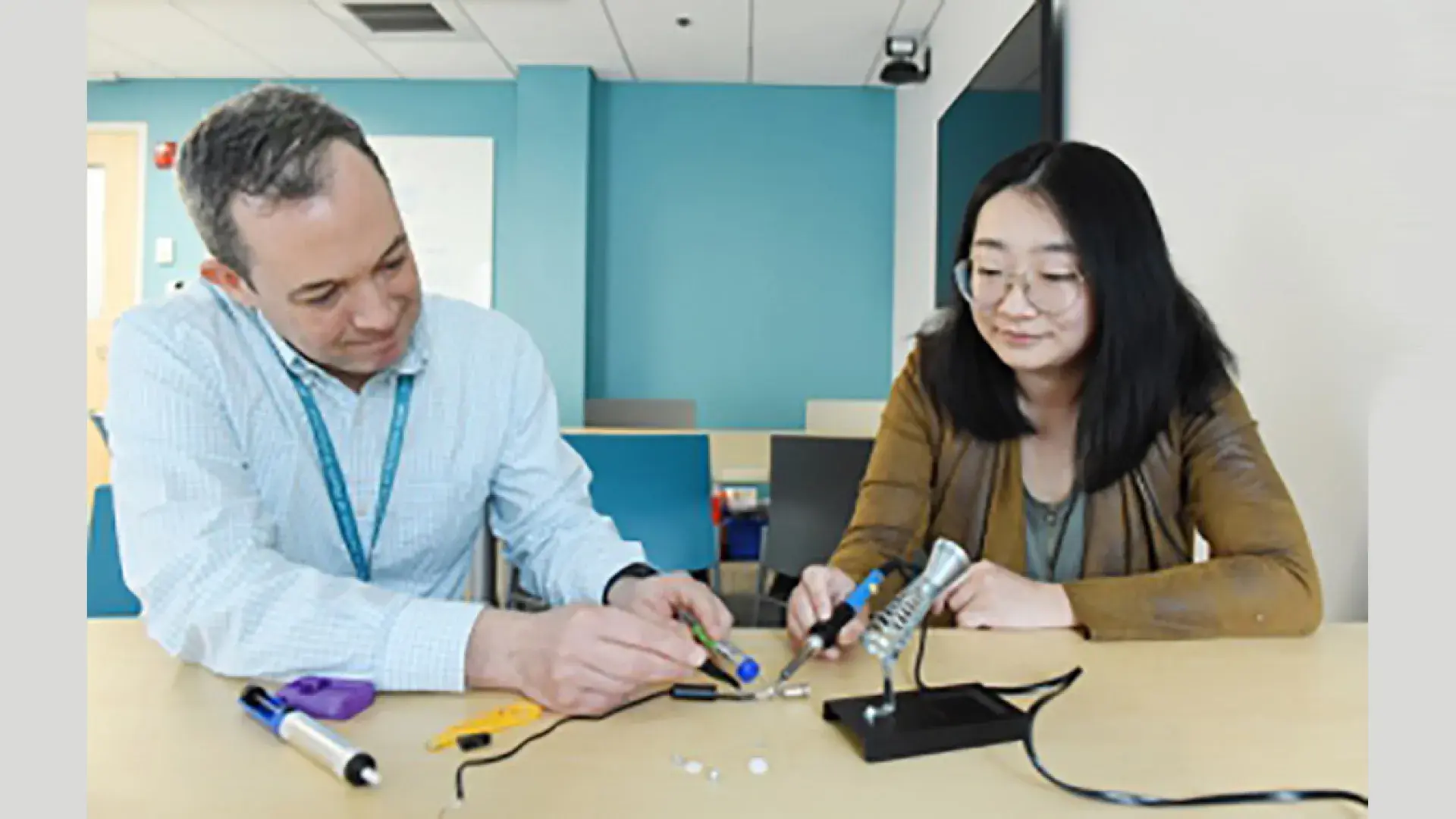


Jiaolin Zhao is among occupational therapy students in Kevin Berner’s Assistive Technology class who are using technology to adapt toys and provide children who have disabilities with the same experience as their nondisabled counterparts.
Teddy Bears.
That’s what assistant professor of occupational therapy Kevin Berner expected when he told students in his Assistive Technology class to bring in a toy that could be modified for use by children with disabilities.
In a classroom filled with chattering and animated stuffed animals, one toy stood apart. It was a bright yellow, child-sized car that Jiaolin Zhao’s children had outgrown. Zhao, who is in her second year in the Doctor of Occupational Therapy program, thought the toy was perfect for repurposing.
“Her project was very ambitious,” said Berner, whose class focuses on how adaptive technology can provide children who have disabilities with the same experience as their nondisabled counterparts.
Zhao, who graduated with a master’s in special education before starting at the IHP in 2020, was undaunted by the challenge. As the mother of two children under the age of seven and a part-time developmental specialist with an early intervention program, she has faced her share of challenges. Hacking a toy car wasn’t one of them.
Using wire, some electronic components, and a large red button along with some pointers from Berner, she adapted the four-foot-long ride-on toy to make it easier to stop and go for children who lack muscle strength or coordination. She then donated the modified auto to the early intervention program she works for.
Yet it wasn’t just the creative aspect of readapting the toy that gave her the most satisfaction. It was the giving part. “It makes me feel like what I’m doing is rewarding and that sometimes you can really make a difference,” said Zhao, a Milton resident who originally is from Beijing, China. “Besides, maybe it will inspire more people to do something similar.”
Patricia Gardner with Aspire Health Alliance, who supervises Zhao at the early childhood intervention program, said assistive technologies like the modified car are extremely important because it allows toddlers to be included playing alongside other children.
There’s also a price factor. “Adaptive toys are so cost prohibitive,” noted Berner. “A $10 toy might be $70 or more once it is modified so being able to offer them at a reduced price or even free is extremely valuable.”
The prototypes his students created, most of which are stuffed animals, are wired and soldered and re-stitched back together before they are donated to organizations that work with children with disabilities.
After the assistive toys were distributed, Zhao still had one more challenge to complete – taking the Assistive Technology Professional Certification test. Despite all she is juggling at home and at school, and facing an exam with a 58 percent first-time failure rate, she passed it easily.
Most OTs must work for several years before they have the experience to qualify for this certification exam, noted Berner, but Zhao was able to qualify using her experience as a developmental specialist and used knowledge from her classes and independent study efforts to earn this specialty certification. “Earning this certificate as a full-time OT student is remarkable,” Berner said, “and it is reflective of her commitment to clinical excellence.”
Looking ahead, Zhao plans to bring her knowledge back to China to help children with disabilities in her homeland—just one more way she wants to make a difference.