

Hogan Plays Key Role in Helping Shape Commonwealth’s New Landmark Literacy Law


Veteran researcher served on “Right to Read” task force; helped put teeth behind implementation
Elementary students heading to school next fall will benefit from more stringent reading curriculums thanks to a new law MGH Institute researcher Tiffany Hogan played a key role in shaping.
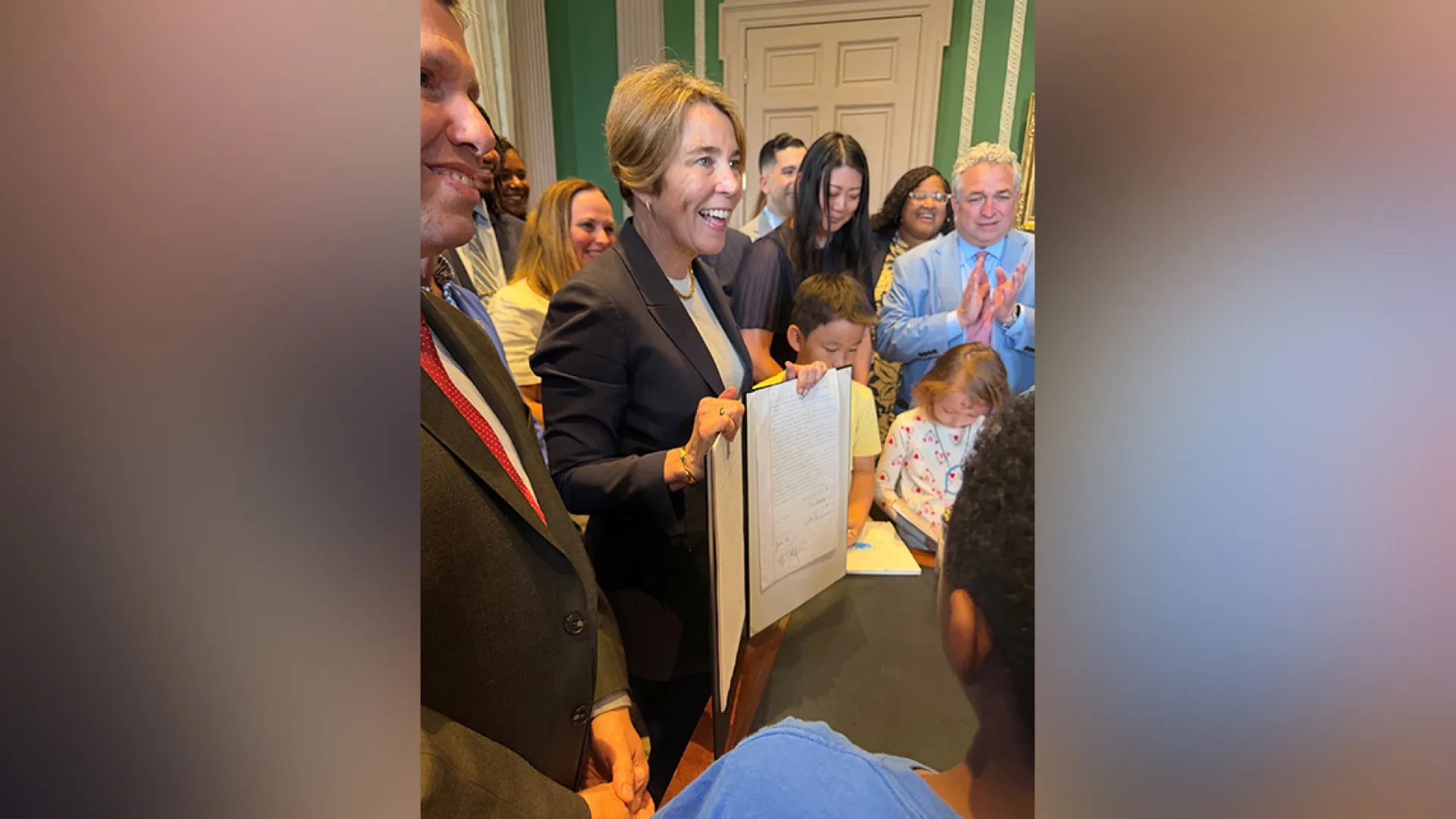
The Right to Read Act, recently signed into law by Governor Maura Healey, overhauls how reading is taught from kindergarten through third grade. Among the provisions: requires public schools to use evidence-based reading practices; creates standards for instruction; limits “three-cueing,” where students use images to help with a word; requires universal literacy screenings, expands teacher training requirements; enforces regular screening for dyslexia and other reading difficulties; and creates new measures meant to track district compliance and student progress.
Hogan was one of the experts on the 12-member task force that shaped what’s in the law and its implementation.
“It was a real honor to be at the table working on this initiative because it means that children with learning difficulties were included in this conversation, which is the focus of my research,” said Hogan. “Having scientists involved is not always a given, so I think having us help shape this new law was critically important.”
This law builds on Literacy Launch, an earlier state initiative that provided funding for evidence-based curricula and professional development. The difference is that Literacy Launch lacked a requirement for district-level enforcement of the programs being funded.
"This is the law that gives the mandate," said Hogan, who missed the bill signing because she was running a dyslexia and language disabilities conference in Puerto Rico. "Not only are these funds in use, but now you have a limited set of curricula that can be purchased — they have to be evidence-based and meet standards."
A Law with “Teeth” to Close the Achievement Gap
Massachusetts has long been ranked tops in the nation for outstanding reading scores, but Dr. Hogan highlighted an important disparity.
"What's ignored in that statistic is the gap that we have, where some students are struggling more than others — from marginalized communities and those who have disabilities," remarked Hogan, director of the Institute’s Speech and Language (SAiL) Literacy Lab. "So, it's really about closing the achievement gap that we see in Massachusetts."
Statewide, only 42% of third graders are meeting the English language arts expectations, with lower rates among students of color, low-income students, English learners, and students with disabilities.
“This is a real movement to actually provide these guardrails in Massachusetts to ensure that the children who are not making progress receive the evidence-based instruction and assessment that they need to make those achievements,” noted Hogan. “So, it's really about closing the achievement gap that we see in Massachusetts.”
Up until now, the Commonwealth didn’t have the authority to control the reading curriculums used by its nearly 400 school districts, resulting in dozens of districts using “low quality” curriculums that were not evidence-based, and the state was powerless to do anything about it. The Right to Read law changes that.
"I commend School board members who are serving their communities, but many times they're not experts in the evidence around science,’ noted Hogan. “This will help community school boards make better decisions because they'll have guidance from experts that actually know what is evidence-based."
Hogan, whose research is on closing the gap between evidence-based practices and what happens in everyday schooling, calls the Right to Read Law a lever to be used.
“This would be a policy lever that would provide support and mandates for schools to actually start to think very clearly about, ‘Is their curriculum evidence-based, and are they actually providing it in the way they should to all students?’, said Hogan. “This law is very directly related to the work I do. I have the opportunity to work across the country with state departments of education and with schools across the U.S. to try and make sure that they have the systems in place for evidence-based instruction.”
Hogan’s research is funded by the National Institutes of Health’s National Institute on Deafness and Other Communication Disorders and the Department of Education’s Institute of Education Sciences. She also serves on national committees of the American Speech-Language-Hearing Association, is an elected board member of the Society for the Scientific Study of Reading, and hosts the SeeHearSpeak podcast, which explores research on speech, language, and literacy development.
The new law will take effect for the 2027-2028 school year. Hogan says she hopes the Department of Education and local schools will receive the support needed as they begin implementation.
"This is just the beginning,” said a beaming Hogan. “The law is there to support the amazing, dedicated educators we have here in Massachusetts — it's just one more way to support the amazing work that they do.”