Partnership allows medical students to pursue second degree; model could be scaled to other health professions programs

The MGH Institute’s Data Analytics program is about to go international. 

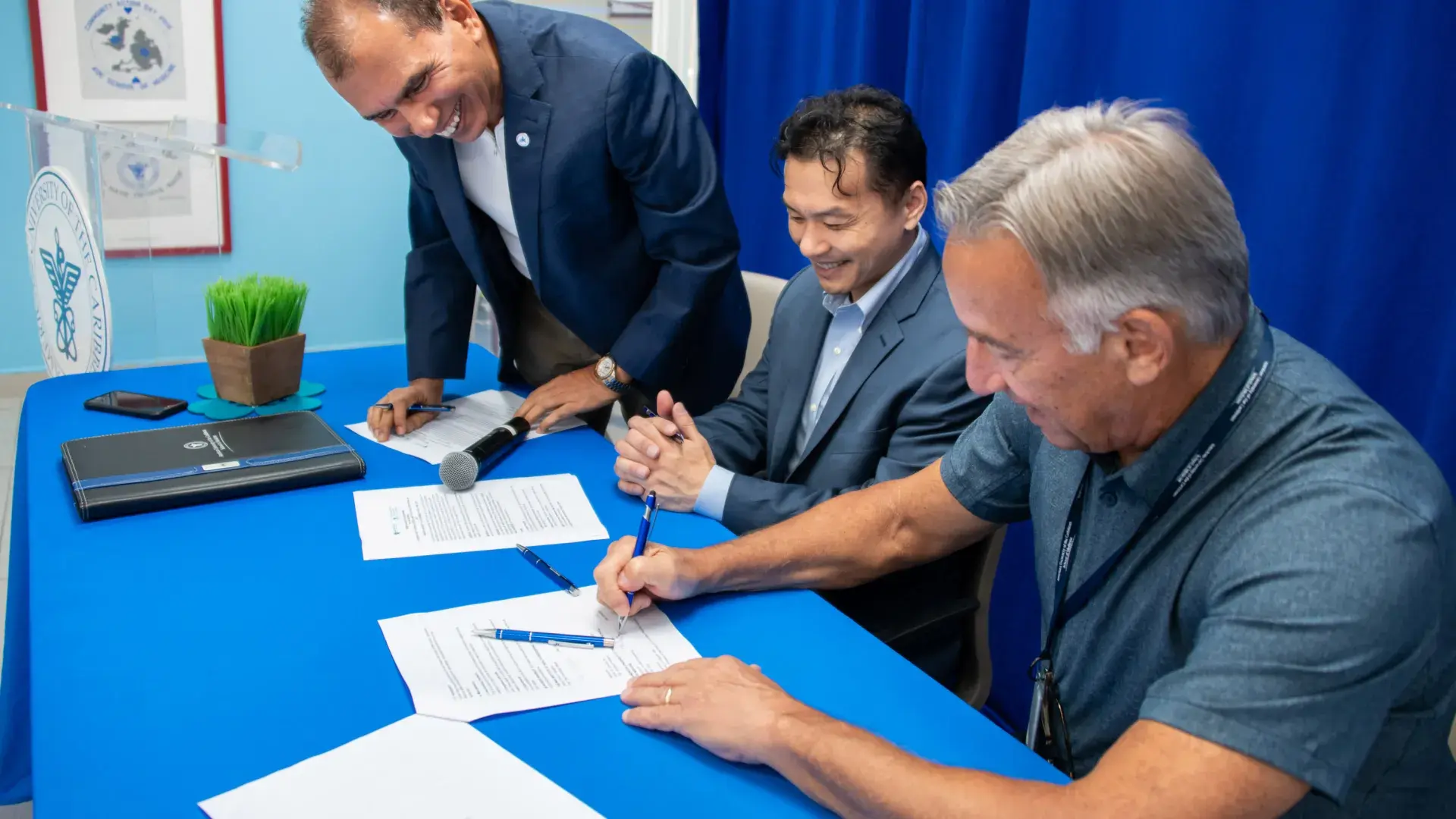
Program director Dr. Shuhan He has inked a Memorandum of Understanding (MOU) with the American University of the Caribbean (AUC) School of Medicine Sint Maarten that would enable high-performing medical school students to pursue their Master’s in Healthcare Data Analytics (MSDA) while simultaneously pursuing their Doctor of Medicine (MD) degree. 

“What we're finding more and more that folks want to not only have the traditional medical school curriculum,” said He, an emergency room doctor at Massachusetts General Hospital, “but also modern tools and technology that will help them become good doctors, and also set themselves apart as data informed, technology enabled future physicians.”

Officially called the MGHIHP-AUC-Gateway for Innovative Careers in Medical Technology, it’s been nicknamed a “MAGIC” partnership. 

The seeds for the agreement were planted a year ago when the He’s Healthcare Data Analytics program hosted an innovation conference in 1 CW for medical professionals. Among the attendees was Dr. Gautam Ullal, Professor of Neuroscience and Chair of Basic Medical Sciences at American University of the Caribbean School of Medicine, who struck up a conversation with Dr. He. 

"Following that, we collaborated with the focus being, 'What can we do for our students at AUC? What MGH Institute programs can we offer them in parallel to their medical degree pursuits?" recalled Ullal. "So, that is how this partnership began." 

More than 40 Zoom conversations led to a signed MOU on May 28th. AUC medical students can enroll in innovative, online courses offered by the Institute and learn artificial intelligence (AI), machine learning, and healthcare data analytics. Students have a range of options: free certificate programs, Micro-Masters, or the Master of Science degree. 

“This partnership reflects a shared commitment to advancing medical education by integrating global expertise with state-of-the-art technology,” said Ullal. “AUC students and faculty gain access to unparalleled opportunities for practical learning, skill development, and academic enrichment through engagement with leading professionals at MGH IHP.”

Since enrollments opened less than a month ago, interest has been strong; more than 50 students have applied

three men at a blue table signing some papers
(from l to r): Gautam Ullal, Professor of Neuroscience and Chair of Basic Medical Sciences at American University Caribbean; Shuhan He, MGH Institute of Health Professions Healthcare Data Analytics program director; and Dr. Mark E. Rosenberg, MD, FASN, Dean of the American University of the Caribbean School of Medicine (AUC) as they signed the Memorandum of Understanding allowing medical school students to pursue their Master’s in Healthcare Data Analytics while simultaneously pursuing their Doctor of Medicine (MD) degree.
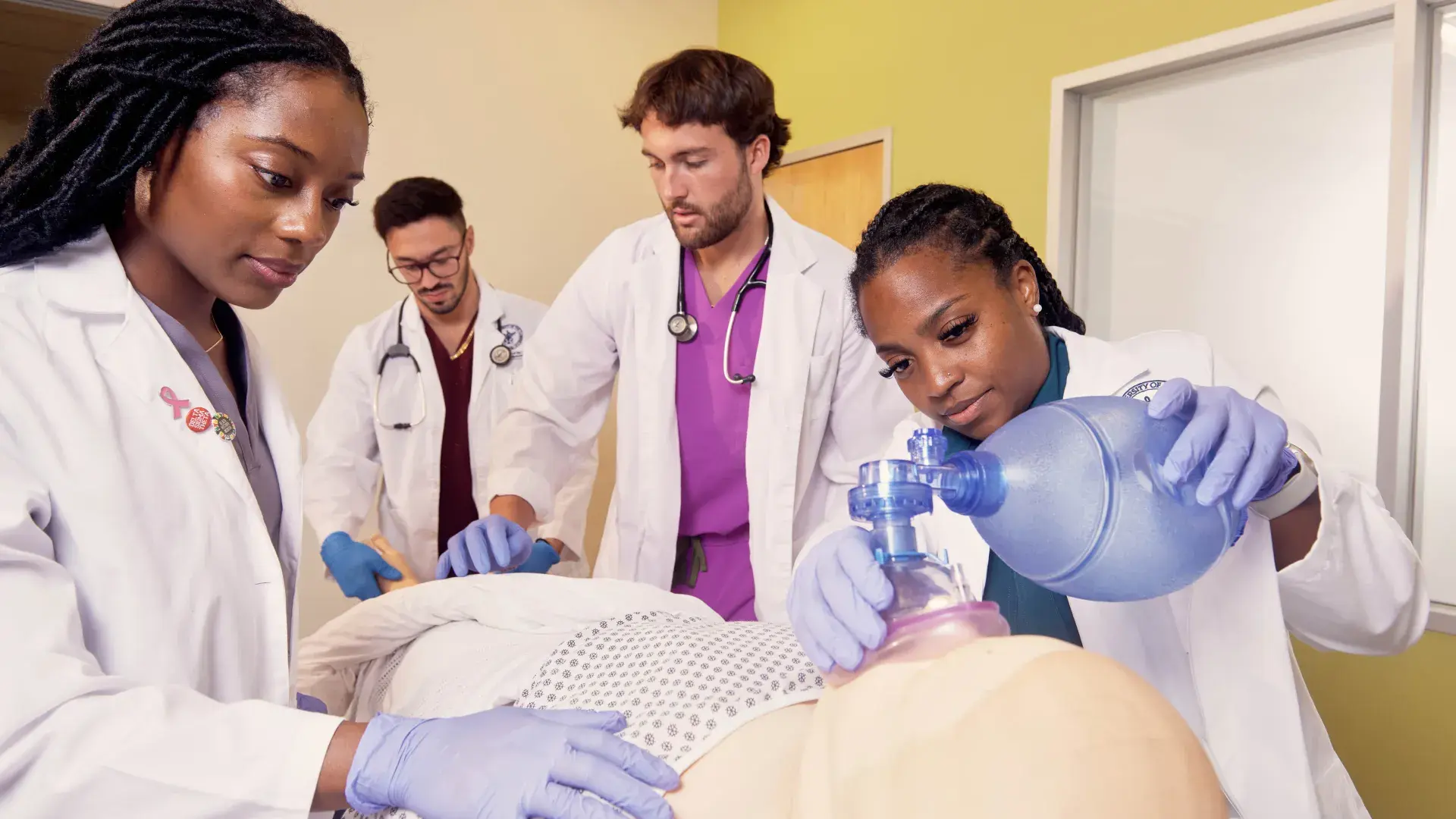
“There's a long, tried and true path for MD PhDs and MD Master's programs, which are very common,” said Dr. He. “This is just a new path. Instead of doing an MBA or a PhD, you would do an MDSA, or a Master's in Healthcare Data Analytics. We feel this is an incredibly unique skillset, especially learning things like A.I. and machine learning, which is now a critical skill for future physicians.”

Besides additional knowledge, the goal is to help differentiate medical school students in the competitive medical landscape. 

"Students in this program graduate with a second degree that not only enriches their medical education but also significantly strengthens their residency applications," said Dr. He. "They gain a highly relevant skill set in applied healthcare data analytics—an area of growing importance in clinical decision-making and health systems innovation. This expertise gives them a clear edge as future physician-leaders.

As the partnership launches, Dr. He is already envisioning a broader impact.

“As we validate this model, my goal is to expand it across academic medicine—beginning with medical schools, but also extending to nursing, physician assistant, and physical therapy programs,” said Dr. He. “There is no reason why future healthcare professionals across disciplines shouldn't have access to dual training in AI, machine learning, and healthcare data analytics. These are no longer optional competencies—they are essential for delivering high-quality, data-driven care.”

According to Dr. He, data analytics is no longer a luxury—it is a core competency for leadership in healthcare.

“Healthcare leaders today are expected to make decisions that are evidence-based, measurable, and accountable,” said Dr. He. “Whether it’s addressing surgical site infections, reducing hospital readmissions, or improving throughput in outpatient clinics, these initiatives all depend on the ability to interpret clinical and operational data. Leaders must know how to engage with dashboards, question data assumptions, and translate insights into system-level improvements.

 “This isn't just about working with analysts—it's about understanding enough to lead effectively in a data-rich environment. Without that fluency, it’s difficult to drive quality improvement, implement new technologies, or meet regulatory and financial benchmarks.”

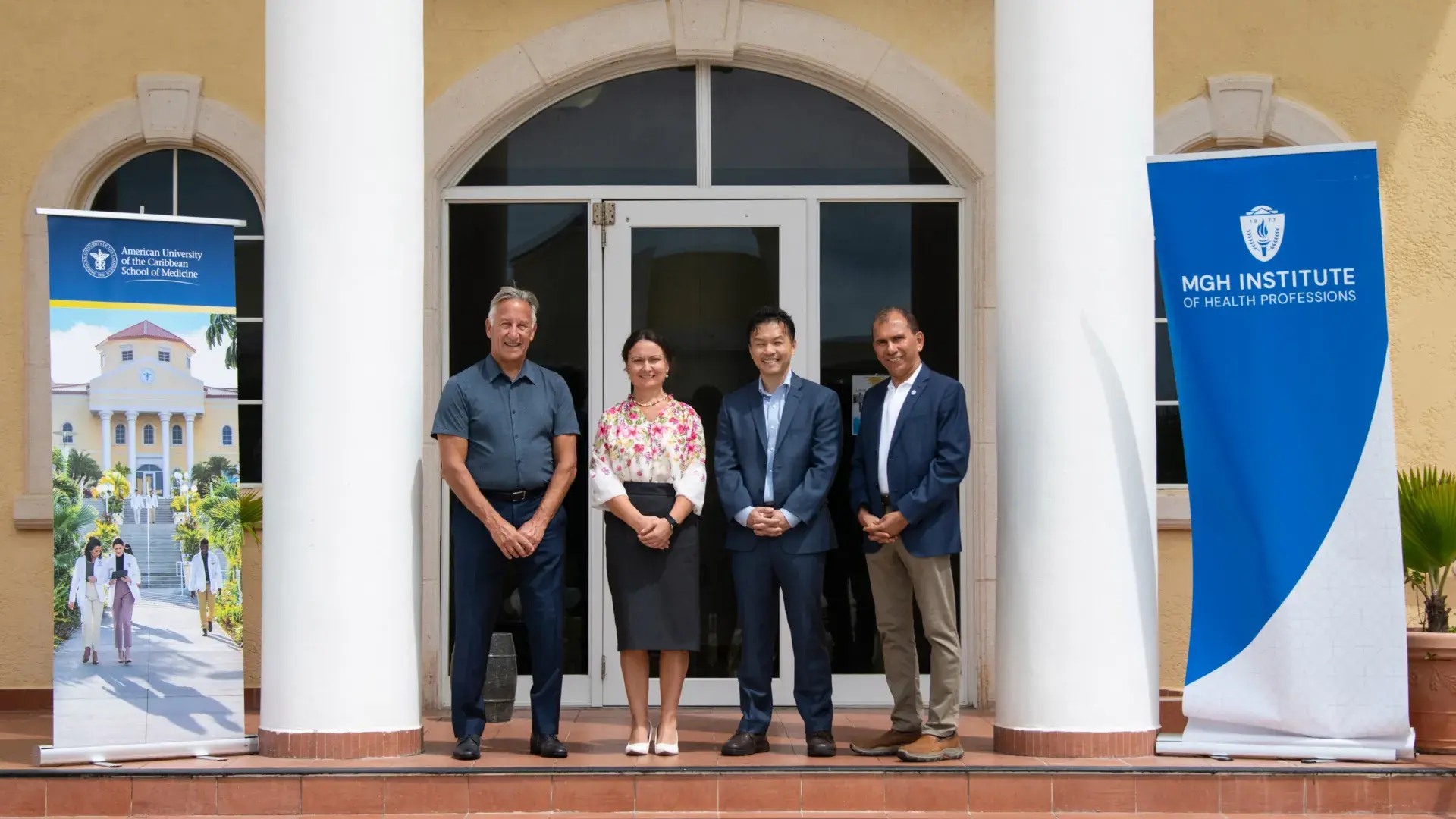
4 people standing on a porch between two columns
(from l to r): Dr. Mark E. Rosenberg, MD, FASN, Dean of the American University of the Caribbean School of Medicine (AUC); Dr. Magda Kwiatkowska, Chair of Clinical Medical Sciences & Sr. Assoc Dean Medical Education; Shuhan He, MGH Institute of Health Professions Healthcare Data Analytics program director; and Gautam Ullal, Professor of Neuroscience and Chair of Basic Medical Sciences at American University Caribbean outside the American University of the Caribbean School of Medicine.

With the launch of this partnership, Dr. He sees the beginning of a broader shift in healthcare education.

“This is about reimagining what it means to train a modern clinician,” he said. “We’re building a pipeline of professionals who are not only exceptional in clinical care but also fluent in the tools that will define the future of medicine—AI, machine learning, and data analytics. This model, we hope, will become the norm across medical, nursing, and allied health education.”


Do you have a story the Office of Strategic Communications should know about? If so, let us know.