

Focusing on Adolescent Reading Challenges
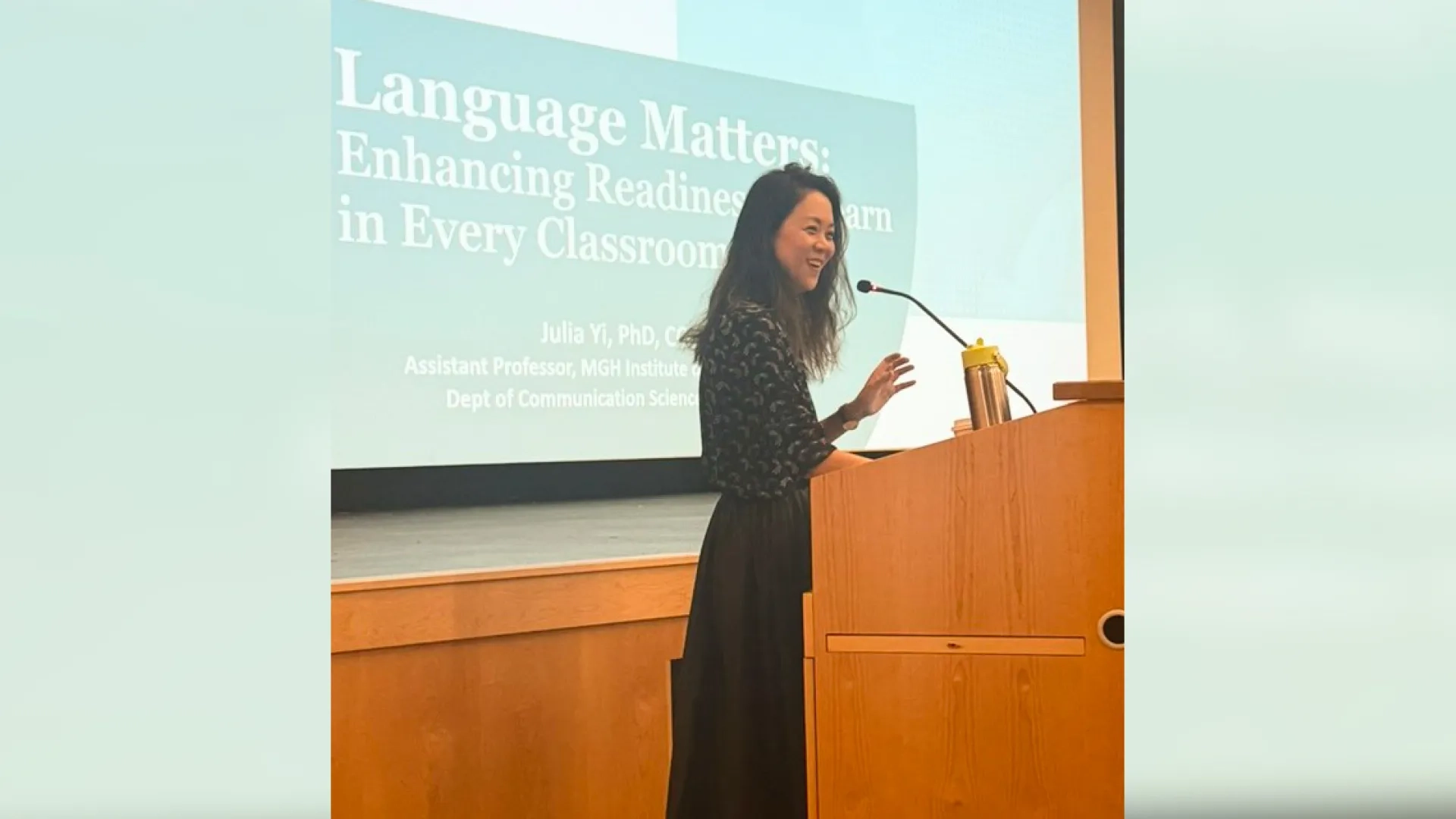


Julia Yi is looking to address gap in availability of instructional resources to support the language and literacy of older students
There is an adolescent literacy crisis, and it is getting worse.
Understanding content, reading, and writing are all essential to doing well in school and beyond. Despite this, adolescent literacy challenges don’t receive widespread attention, and commonly used literacy interventions are not always age appropriate. Communication Sciences and Disorders Assistant Professor Julia Yi is working to change that.
The state of adolescent literacy
Testing done by the National Assessment of Educational Progress (NAEP) found that one-third of eighth and twelfth graders scored below the Basic level, not even reaching the lowest level of reading proficiency. Scores of eighth and twelfth graders continue to decline, with the largest decline seen among students with the lowest reading scores, indicating that students with or at-risk for disabilities are particularly struggling according to the 2024 National Center for Education Statistics.
Dr. Yi first saw the reading challenges that many adolescents face first-hand during her 10 years as a speech-language pathologist in public schools. Working primarily with middle schoolers in underserved areas in New York City and Los Angeles, she saw how their language and literacy challenges intensified as they got older because of the increasing linguistic complexities across all subjects in the curriculum. Many times there was a substantial gap between their grade and their reading level, which was often below a 4th grade reading level.
Many students she interacted with needed to work on foundational literacy skills, which is a common problem. Surveys of middle and high school English Language Arts teachers post-pandemic showed that up to 40% report spending significant instructional time on foundational reading skills — skills students are expected to have mastered years earlier.
However, commonly used literacy programs weren’t developed or designed for older students.
“When I looked more closely at the research base for teaching adolescents to read, I found a striking blind spot: every study included in the landmark National Reading Panel's 1999 report on phonics involved elementary-age students,” said Yi. “In other words, the field has largely been assuming and perhaps over-generalizing instructional practices proven effective for young children, like phonics and phonemic awareness instruction, to be equally as effective for older readers.”
Yi’s collective experiences in classrooms and interactions with educators who have similar concerns about adolescent literacy have shaped the direction of her research career.
“I chose to focus on adolescent literacy, driven by a desire to close the current gap in research-based understandings and evidence-based practice for older students with language and literacy challenges,” she noted.
Looking at the research
To investigate effective approaches for supporting middle and high school students’ word reading, Yi and her colleagues conducted a meta-analysis — a research method that systematically synthesizes findings across all available studies on a given topic. It was a substantial undertaking, requiring collaboration with co-authors from Penn State, UNC Chapel Hill, and UNC Greensboro, along with graduate research assistants from the MS in Speech-Language Pathology program at the MGH Institute.
They investigated the effectiveness of interventions for adolescents in which word reading was the primary component and examined potential moderators.
“Language-based approaches to teaching word reading involves explicitly teaching students the language structures of words, usually sounds or morphemes” explained Yi. “So, if a student comes across a word like reaffirmation, I might teach them to look for word parts like re – affirm- a-tion, or I might teach them how -tion is pronounced as ‘shun’.”
That way of teaching reading is in contrast to whole word (sight word) instruction, which involves simply memorizing whole words, usually through flash cards.
Across the 29 studies analyzed by the researchers, the results showed that word-reading interventions produced what would be considered a large effect size — meaning there was a substantial and meaningful degree of improvement.
“Two findings stood out as particularly promising,” shared Yi. “First, this large, significant effect emerged even though the average intervention lasted just three months. Second, even though these interventions didn't directly target reading comprehension, students showed comparable gains in comprehension as they did in decoding, suggesting that word-reading may be a barrier and a key to unlocking reading comprehension for some adolescents.”
In contrast, teaching whole-word instruction had close to no effect. Having to memorize whole words doesn’t actually teach anything, except how to memorize them.
Secondary school may be the last chance many will have to really learn how to read. The analysis by Yi and her colleagues demonstrated that higher grade levels were linked to larger intervention effects, showing it’s never too late to teach foundational reading skills.