

Fifth Annual Petzold Lecture Highlights Advancements in Digital Health Innovation
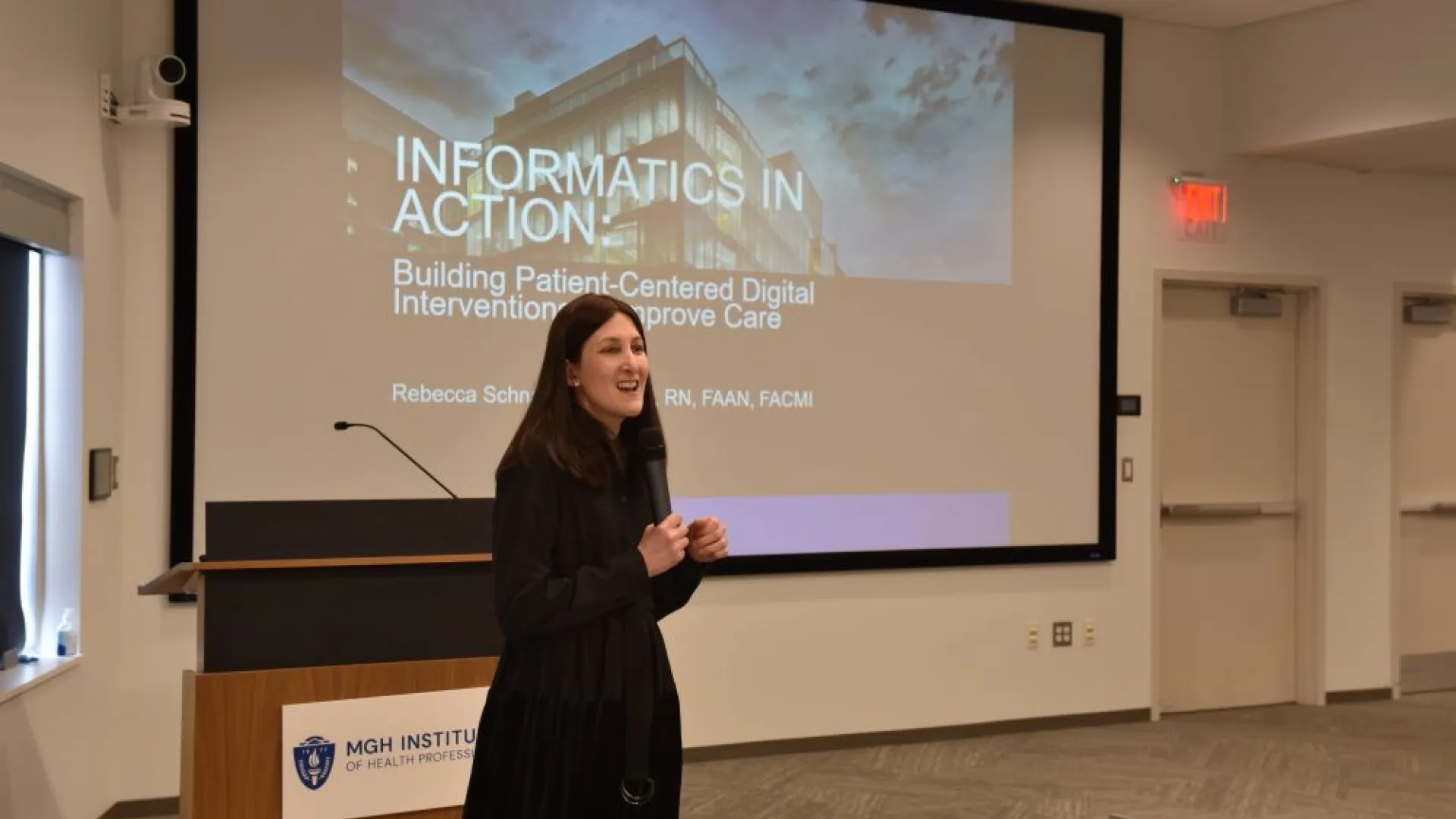


MGH Institute faculty and staff gathered for the fifth annual lecture honoring the legacy of nursing leader Natalie Petzold, whose impact continues to shape the Institute and the field of nursing education.
Petzold, remembered fondly as “Miss Petzold,” played a pivotal role in the evolution of the Massachusetts General Hospital School of Nursing and its transition into the Institute. She oversaw the graduation of the school’s final diploma class in 1981 and later welcomed the first class of students to the Institute in 1982 as Director of Student Services. Colleagues described her as a visionary leader, mentor, and pioneer who championed innovation and student growth.
“Many of us can point to leaders who shaped our careers, and Miss Petzold was one of those people to me,” Margie Sipe, Associate Dean for Academic Affairs in the School of Nursing, reflected.
This year’s lecture featured Rebecca Schnall, the Mary Dickey Lindsay Endowed Professor of Nursing at Columbia University School of Nursing and a previous colleague and mentor of the Institute’s Dean of Nursing, Maura Abbott.
Schnall, who also serves as Associate Dean for Faculty Development, presented her work on user-centered design in mobile health technologies.
Her research focuses on improving access to health information and outcomes for individuals living with and at risk for HIV. Through a series of studies, Schnall demonstrated how engaging patients directly in the design process, from focus groups to app prototyping, can lead to more effective, culturally responsive digital tools.
“Community engagement is foundational,” Schnall said, emphasizing that patient input drives both innovation and trust in healthcare technology.
Her work includes mobile health applications that support medication adherence, wearable technologies that help reduce smoking, and large-scale digital studies that enable individuals to self-test for HIV and other conditions at home. Across these projects, Schnall highlighted the importance of design, combining qualitative and quantitative research, and addressing broader social determinants of health.
The lecture also marked the beginning of Schnall’s role as a visiting scholar at the Institute, where she will collaborate with faculty to advance nursing research.
“This is the start of all good things to come,” said Abbott when introducing Schnall. “We will be partnering with the SHRS to work on advancing nursing research here under Rebecca's tutelage over the next year.”
As attendees reflected on both Petzold’s legacy and Schnall’s forward-looking work, the event underscored a shared theme: the power of innovation, mentorship, and community-centered approaches to shape the future of healthcare.