

Building Solutions That Matter
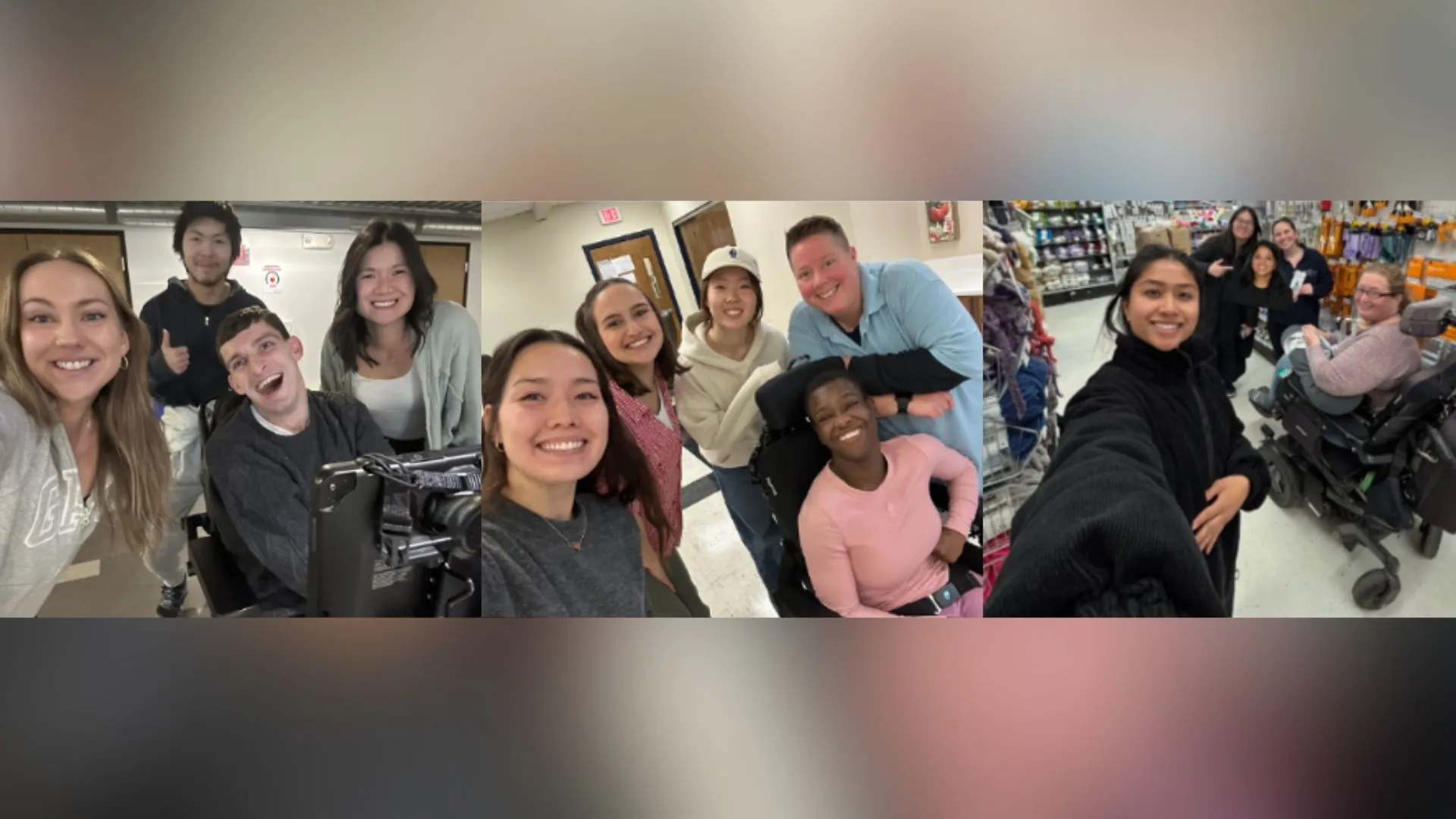


At an assistive technology hackathon, students and community co-designers turned everyday challenges into meaningful innovations
Nine MGH Institute students may have signed up to take part in a hackathon but by the time the projects wrapped up, it was clearly about more than just prototypes, presentations, and prizes. It was about people.
At this year’s Intercollegiate Assistive Technology Hackathon (IATH), 35 students across 10 teams collaborated with co-designers to create devices that were not only functional, but deeply personal. Over the course of a week, seven occupational therapy and two communication sciences and disorders students from the MGH Institute were among the students who worked side by side with community members to design solutions that addressed the co-designers’ real, everyday challenges.
What sets this hackathon apart was the approach. Each team worked directly with a co-designer, someone who would ultimately use the device. Students stepped outside their usual roles and learned from peers in other disciplines and from the co-designers themselves. Engineering students worked alongside future clinicians. Ideas were tested, adjusted, and sometimes completely reworked in real time. The result was a process driven not by assumptions, but by lived experience.
By the end of the hackathon, which received funding for supplies and prizes from Cecropia Strong, three teams were recognized for their work. For the MGH Institute students on each of the winning teams and the co-designers, the impact of the event went far beyond the awards.
For one team, innovation meant rethinking something as simple as a rain cover.
Nick, the team’s co-designer, uses an eye-tracking communication device. When it rained, he had to rely on a plastic bag to protect it, but the bag blocked the eye-tracking system, making it nearly impossible for him to communicate.
“Our challenge was to create something that actually worked with the device, not against it,” said Mia Obermueller, an MGH Institute Communication Sciences and Disorders student.
The team experimented with different materials and designs, eventually landing on a clear, waterproof cover with a structured top and a built-in sunshade. The cover could be lifted when needed, allowing the device to function without interference while still offering protection. The result was Nick’s AAC Rain Cover, which was recognized as the Most Innovative in this year’s hackathon.
For Obermueller, the experience was eye-opening. Working directly with Nick changed the way she approached the design.
“It gave the project a stronger sense of purpose,” said Obermueller. “We weren’t just making something, we were making something for him.”
Another winning team focused on a different kind of challenge.
Their co-designer, Crystal, has neuromuscular weakness and uses a tracheostomy. She relies on a pillow for positioning in bed, but it frequently shifts out of place, making it difficult to stay comfortable and properly supported.
Instead of creating something complex, the team leaned into simplicity. They designed a modified pillowcase that could be sewn directly onto a fitted sheet, keeping the pillow securely in place without interfering with medical equipment.
“From the beginning, we wanted Crystal involved in every step,” said Cait Rocco, an Occupational Therapy student at the IHP. “She knew what had and had not worked for her before, and that made all the difference.”
That level of collaboration became the foundation of the project. It shaped not only the final design, but the process itself. When the team was awarded “Most Collaborative,” it reflected exactly how they had worked from start to finish.
The team that won the award for being most functional brought a device called the “Zambroomi” to life.
Dede, the team’s co-designer, wanted to be able to sweep floors independently. Managing a broom, a dustpan, and a wheelchair at the same time made that nearly impossible.
Her team set out to change that. They designed a broom attachment that connects directly to the foot pedals of her wheelchair using 3D-printed components and metal supports. The device allows her to sweep while moving, turning a frustrating task into something manageable.
For OT student Alia Yannone, the most memorable moment came when Dede tried it for the first time.
“You could just see how happy she was,” Yannone said. “That moment made everything worth it.”
The solutions did not end when the awards were distributed. Some students are already thinking about how to refine their designs. Others have seen past projects continue to be used long after the hackathon ended. That is what stayed with many of them.
“It makes all the hard work worth it,” Yannone said. “Seeing the impact you can have on someone’s life, even in a small way, is something you don’t forget.”